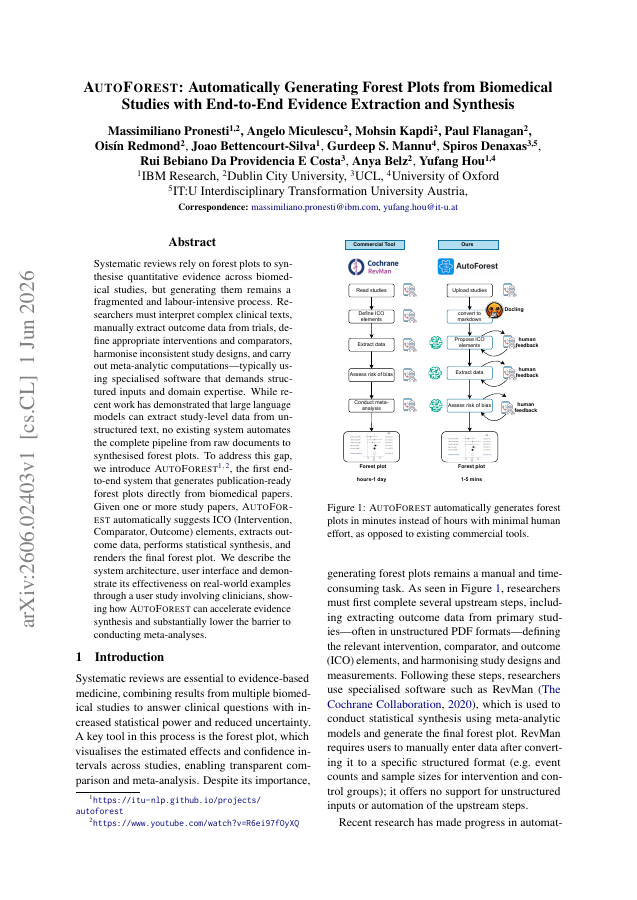
Systematic reviews rely on forest plots to synthesise quantitative evidence across biomedical studies, but generating them remains a fragmented and labour-intensive process. Researchers must interpret complex clinical texts, manually extract outcome data from trials, define appropriate interventions and comparators, harmonise inconsistent study designs, and carry out meta-analytic computations-typically using specialised software that demands structured inputs and domain expertise. While recent work has demonstrated that large language models can extract study-level data from unstructured text, no existing system automates the complete pipeline from raw documents to synthesised forest plots. To address this gap, we introduce AutoForest, the first end-to-end system that generates publication-ready forest plots directly from biomedical papers. Given one or more study papers, AutoForest automatically suggests ICO (Intervention, Comparator, Outcome) elements, extracts outcome data, performs statistical synthesis, and renders the final forest plot. We describe the system architecture, user interface and demonstrate its effectiveness on real-world examples through a user study involving clinicians, showing how AutoForest can accelerate evidence synthesis and substantially lower the barrier to conducting meta-analyses.
AutoForest: Automatically Generating Forest Plots from Biomedical Studies with End-to-End Evidence Extraction and Synthesis
Systematic reviews rely on forest plots to synthesise quantitative evidence across biomedical studies, but generating them remains a fragmented and labour-intensive process.
- Preview
- Year
- 2026
- Hosting
- Abstract onlyARXIV-DEFAULT
Cite
Notes
Only stored in your browser.
Attribution
- Abstract & full text
- arxiv.org/abs/2606.02403ARXIV-DEFAULT
- TL;DR
- Semantic Scholar