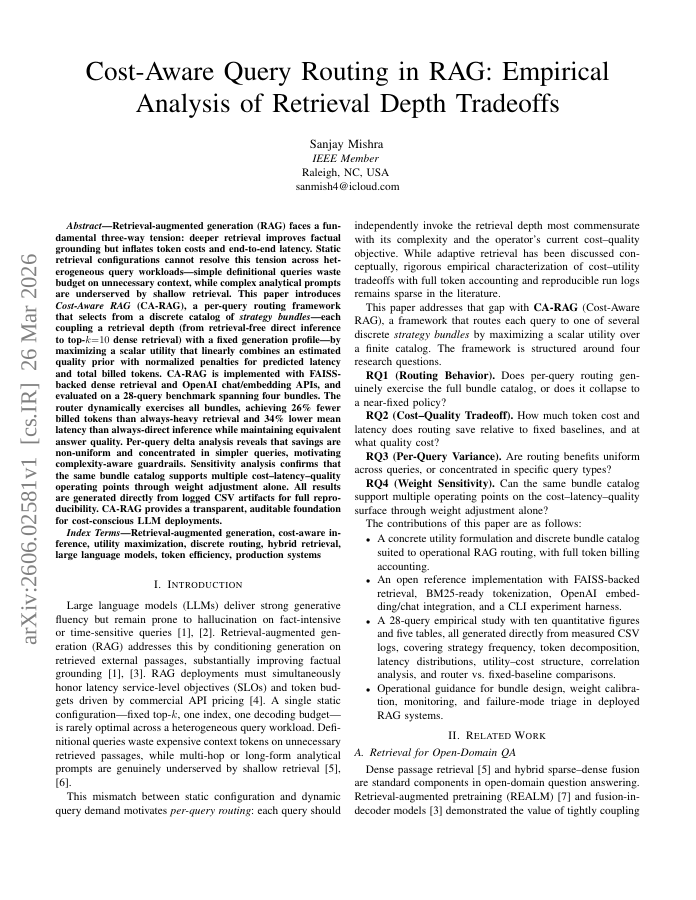
Retrieval-augmented generation (RAG) faces a fundamental three-way tension: deeper retrieval improves factual grounding but inflates token costs and end-to-end latency. Static retrieval configurations cannot resolve this tension across heterogeneous query workloads -- simple definitional queries waste budget on unnecessary context, while complex analytical prompts are underserved by shallow retrieval. This paper introduces Cost-Aware RAG (CA-RAG), a per-query routing framework that selects from a discrete catalog of strategy bundles -- each coupling a retrieval depth (from retrieval-free direct inference to top-k{=}10 dense retrieval) with a fixed generation profile -- by maximizing a scalar utility that linearly combines an estimated quality prior with normalized penalties for predicted latency and total billed tokens. CA-RAG is implemented with FAISS-backed dense retrieval and OpenAI chat/embedding APIs, and evaluated on a 28-query benchmark spanning four bundles. The router dynamically exercises all bundles, achieving 26% fewer billed tokens than always-heavy retrieval and 34% lower mean latency than always-direct inference while maintaining equivalent answer quality. Per-query delta analysis reveals that savings are non-uniform and concentrated in simpler queries, motivating complexity-aware guardrails. Sensitivity analysis confirms that the same bundle catalog supports multiple cost-latency-quality operating points through weight adjustment alone. All results are generated directly from logged CSV artifacts for full reproducibility. CA-RAG provides a transparent, auditable foundation for cost-conscious LLM deployments.
Cost-Aware Query Routing in RAG: Empirical Analysis of Retrieval Depth Tradeoffs
Retrieval-augmented generation (RAG) faces a fundamental three-way tension: deeper retrieval improves factual grounding but inflates token costs and end-to-end latency. Static retrieval configurations cannot resolve this tension across heterogeneous query workloads -- simple…
- Preview
- Year
- 2026
- Hosting
- Abstract onlyARXIV-DEFAULT
Cite
Notes
Only stored in your browser.
Attribution
- Abstract & full text
- arxiv.org/abs/2606.02581ARXIV-DEFAULT
- TL;DR
- Semantic Scholar