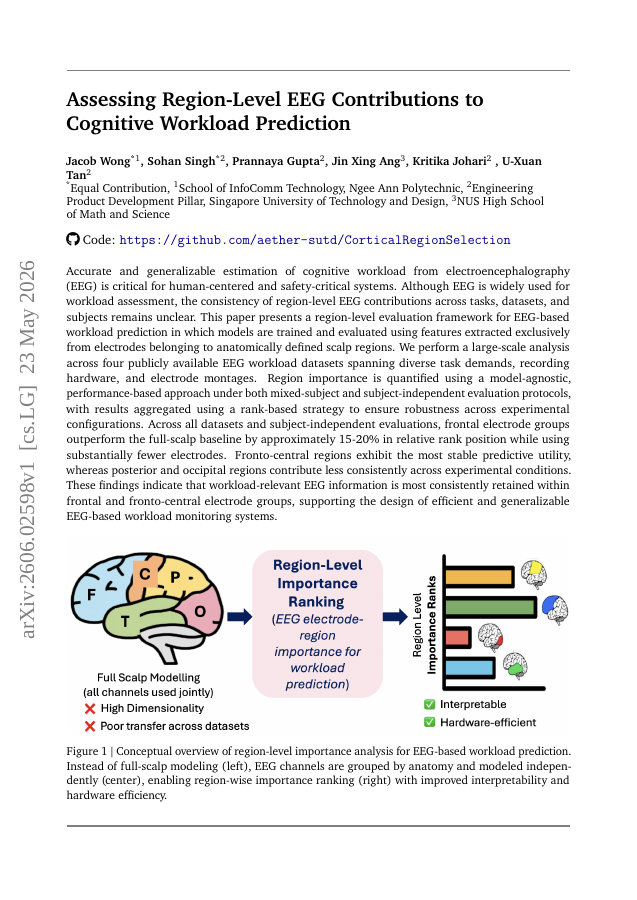
Accurate and generalizable estimation of cognitive workload from electroencephalography (EEG) is critical for human-centered and safety-critical systems. Although EEG is widely used for workload assessment, the consistency of region-level EEG contributions across tasks, datasets, and subjects remains unclear. This paper presents a region-level evaluation framework for EEG-based workload prediction in which models are trained and evaluated using features extracted exclusively from electrodes belonging to anatomically defined scalp regions. We perform a large-scale analysis across four publicly available EEG workload datasets spanning diverse task demands, recording hardware, and electrode montages. Region importance is quantified using a model-agnostic, performance-based approach under both mixed-subject and subject-independent evaluation protocols, with results aggregated using a rank-based strategy to ensure robustness across experimental configurations. Across all datasets and subject-independent evaluations, frontal electrode groups outperform the full-scalp baseline by approximately 15-20% in relative rank position while using substantially fewer electrodes. Fronto-central regions exhibit the most stable predictive utility, whereas posterior and occipital regions contribute less consistently across experimental conditions. These findings indicate that workload-relevant EEG information is most consistently retained within frontal and fronto-central electrode groups, supporting the design of efficient and generalizable EEG-based workload monitoring systems.
Assessing Region-Level EEG Contributions to Cognitive Workload Prediction
Accurate and generalizable estimation of cognitive workload from electroencephalography (EEG) is critical for human-centered and safety-critical systems. Although EEG is widely used for workload assessment, the consistency of region-level EEG contributions across tasks,…
- Preview
- Year
- 2026
- Hosting
- Abstract onlyARXIV-DEFAULT
Cite
Notes
Only stored in your browser.
Attribution
- Abstract & full text
- arxiv.org/abs/2606.02598ARXIV-DEFAULT
- TL;DR
- Semantic Scholar