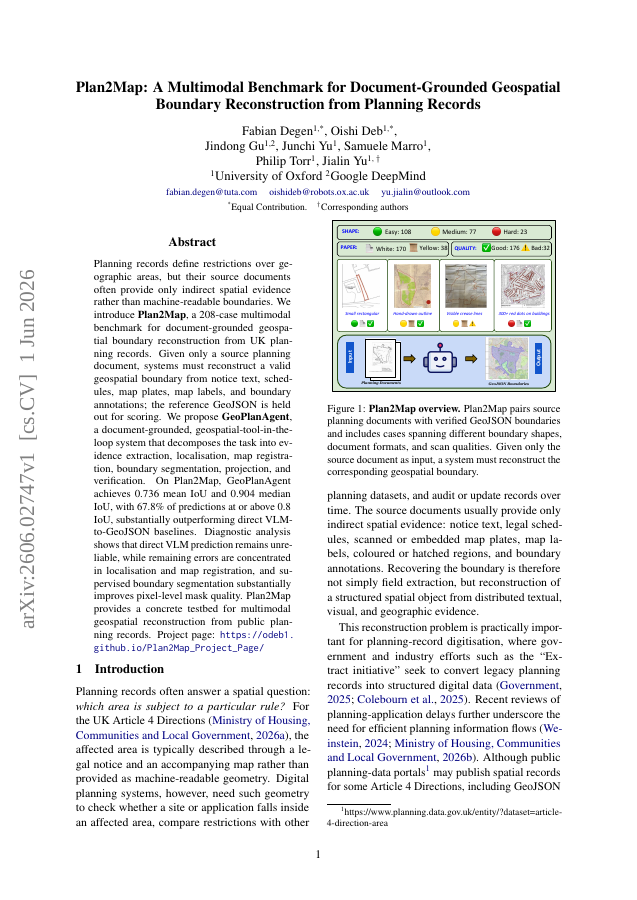
Planning records define restrictions over geographic areas, but their source documents often provide only indirect spatial evidence rather than machine-readable boundaries. We introduce Plan2Map, a 208-case multimodal benchmark for document-grounded geospatial boundary reconstruction from UK planning records. Given only a source planning document, systems must reconstruct a valid geospatial boundary from notice text, schedules, map plates, map labels, and boundary annotations; the reference GeoJSON is held out for scoring. We propose GeoPlanAgent, a document-grounded, geospatial-tool-in-the-loop system that decomposes the task into evidence extraction, localisation, map registration, boundary segmentation, projection, and verification. On Plan2Map, GeoPlanAgent achieves 0.736 mean IoU and 0.904 median IoU, with 67.8% of predictions at or above 0.8 IoU, substantially outperforming direct VLM-to-GeoJSON baselines. Diagnostic analysis shows that direct VLM prediction remains unreliable, while remaining errors are concentrated in localisation and map registration, and supervised boundary segmentation substantially improves pixel-level mask quality. Plan2Map provides a concrete testbed for multimodal geospatial reconstruction from public planning records. Project page: https://odeb1.github.io/Plan2Map_Project_Page/.
Plan2Map: A Multimodal Benchmark for Document-Grounded Geospatial Boundary Reconstruction from Planning Records
Planning records define restrictions over geographic areas, but their source documents often provide only indirect spatial evidence rather than machine-readable boundaries.
- Preview
- Year
- 2026
- Hosting
- Full text hostedCC-BY-4.0
Cite
Notes
Only stored in your browser.
Attribution
- Abstract & full text
- arxiv.org/abs/2606.02747CC-BY-4.0
- TL;DR
- Semantic Scholar