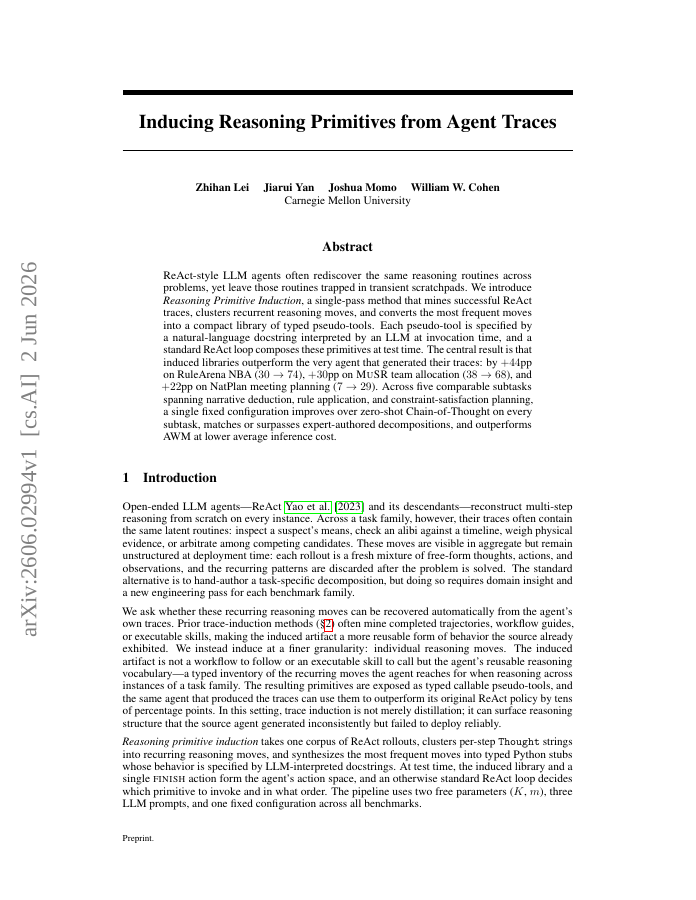
ReAct-style LLM agents often rediscover the same reasoning routines across problems, yet leave those routines trapped in transient scratchpads. We introduce Reasoning Primitive Induction, a single-pass method that mines successful ReAct traces, clusters recurrent reasoning moves, and converts the most frequent moves into a compact library of typed pseudo-tools. Each pseudo-tool is specified by a natural-language docstring interpreted by an LLM at invocation time, and a standard ReAct loop composes these primitives at test time. The central result is that induced libraries outperform the very agent that generated their traces: by +44pp on RuleArena NBA (30 -> 74), +30pp on MuSR team allocation (38 -> 68), and +22pp on NatPlan meeting planning (7 -> 29). Across five comparable subtasks spanning narrative deduction, rule application, and constraint-satisfaction planning, a single fixed configuration improves over zero-shot Chain-of-Thought on every subtask, matches or surpasses expert-authored decompositions, and outperforms AWM at lower average inference cost.
Inducing Reasoning Primitives from Agent Traces
ReAct-style LLM agents often rediscover the same reasoning routines across problems, yet leave those routines trapped in transient scratchpads. We introduce Reasoning Primitive Induction, a single-pass method that mines successful ReAct traces, clusters recurrent reasoning…
- Preview
- Year
- 2026
- Hosting
- Abstract onlyARXIV-DEFAULT
Cite
Notes
Only stored in your browser.
Attribution
- Abstract & full text
- arxiv.org/abs/2606.02994ARXIV-DEFAULT
- TL;DR
- Semantic Scholar