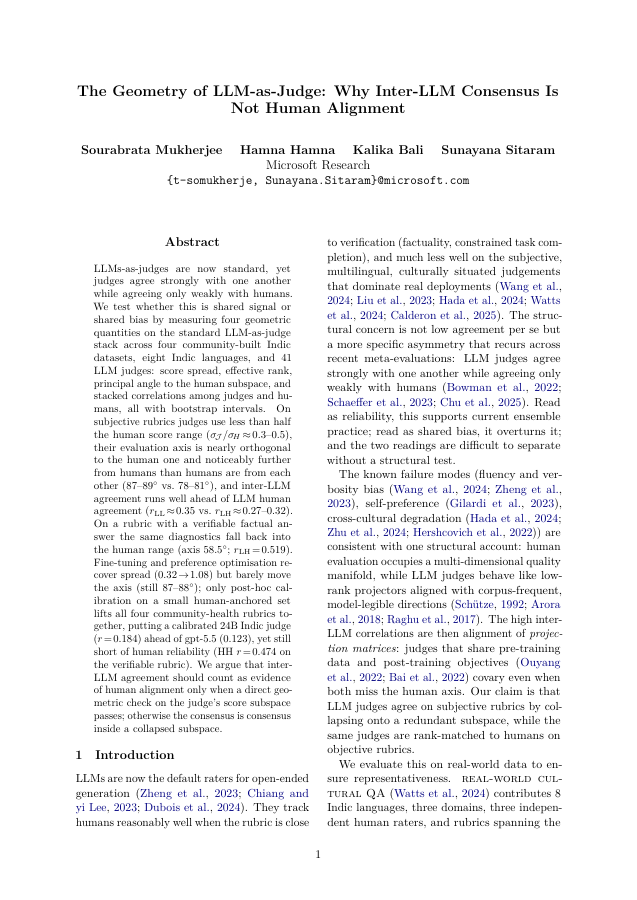
LMs-as-judges are now standard, yet judges agree strongly with one another while agreeing only weakly with humans. We test whether this reflects shared signal or shared bias by measuring four geometric quantities on the standard LLM-as-judge stack across four community-built Indic datasets, eight Indic languages, and 41 LLM judges: score spread, effective rank, principal angle to the human subspace, and stacked correlations among judges and humans, all with bootstrap confidence intervals. On subjective rubrics, judges use less than half the human score range (σ_J / σ_H \approx 0.3--0.5). Their evaluation axis is nearly orthogonal to the human one and noticeably further from humans than humans are from each other (87^\circ--89^\circ versus 78^\circ--81^\circ). Inter-LLM agreement exceeds LLM--human agreement (r_{LL} \approx 0.35 versus r_{LH} \approx 0.27--0.32). On a rubric with a verifiable factual answer, the same diagnostics fall back into the human range (axis 58.5^\circ; r_{LH} = 0.519). Fine-tuning and preference optimization recover spread (0.32 \rightarrow 1.08) but barely move the axis (still 87^\circ--88^\circ). Only post-hoc calibration on a small human-anchored set improves all four community-health rubrics together, placing a calibrated 24B Indic judge (r = 0.184) ahead of GPT-5.5 (r = 0.123), yet still short of human reliability (human-human r = 0.474 on the verifiable rubric). We argue that inter-LLM agreement should be considered evidence of human alignment only when a direct geometric check on the judge's score subspace passes; otherwise, the consensus reflects agreement within a collapsed subspace.
The Geometry of LLM-as-Judge: Why Inter-LLM Consensus Is Not Human Alignment
LMs-as-judges are now standard, yet judges agree strongly with one another while agreeing only weakly with humans. We test whether this reflects shared signal or shared bias by measuring four geometric quantities on the standard LLM-as-judge stack across four community-built…
- Preview
- Year
- 2026
- Hosting
- Full text hostedCC-BY-4.0
Cite
Notes
Only stored in your browser.
Attribution
- Abstract & full text
- arxiv.org/abs/2606.03043CC-BY-4.0
- TL;DR
- Semantic Scholar