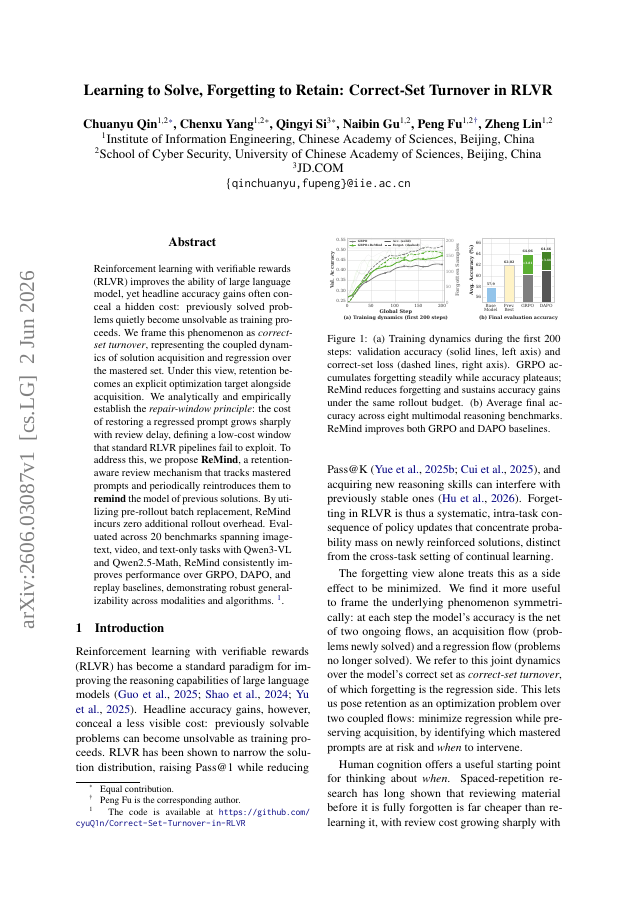
Reinforcement learning with verifiable rewards (RLVR) improves the ability of large language model, yet headline accuracy gains often conceal a hidden cost: previously solved problems quietly become unsolvable as training proceeds. We frame this phenomenon as correct-set turnover, representing the coupled dynamics of solution acquisition and regression over the mastered set. Under this view, retention becomes an explicit optimization target alongside acquisition. We analytically and empirically establish the repair-window principle: the cost of restoring a regressed prompt grows sharply with review delay, defining a low-cost window that standard RLVR pipelines fail to exploit. To address this, we propose \textbf{\method{}}, a retention-aware review mechanism that tracks mastered prompts and periodically reintroduces them to remind the model of previous solutions. By utilizing pre-rollout batch replacement, \method{} incurs zero additional rollout overhead. Evaluated across 20 benchmarks spanning image-text, video, and text-only tasks with Qwen3-VL and Qwen2.5-Math, \method{} consistently improves performance over GRPO, DAPO, and replay baselines, demonstrating robust generalizability across modalities and algorithms.
Learning to Solve, Forgetting to Retain: Correct-Set Turnover in RLVR
Reinforcement learning with verifiable rewards (RLVR) improves the ability of large language model, yet headline accuracy gains often conceal a hidden cost: previously solved problems quietly become unsolvable as training proceeds.
- Preview
- Year
- 2026
- Hosting
- Full text hostedCC-BY-4.0
Cite
Notes
Only stored in your browser.
Attribution
- Abstract & full text
- arxiv.org/abs/2606.03087CC-BY-4.0
- TL;DR
- Semantic Scholar