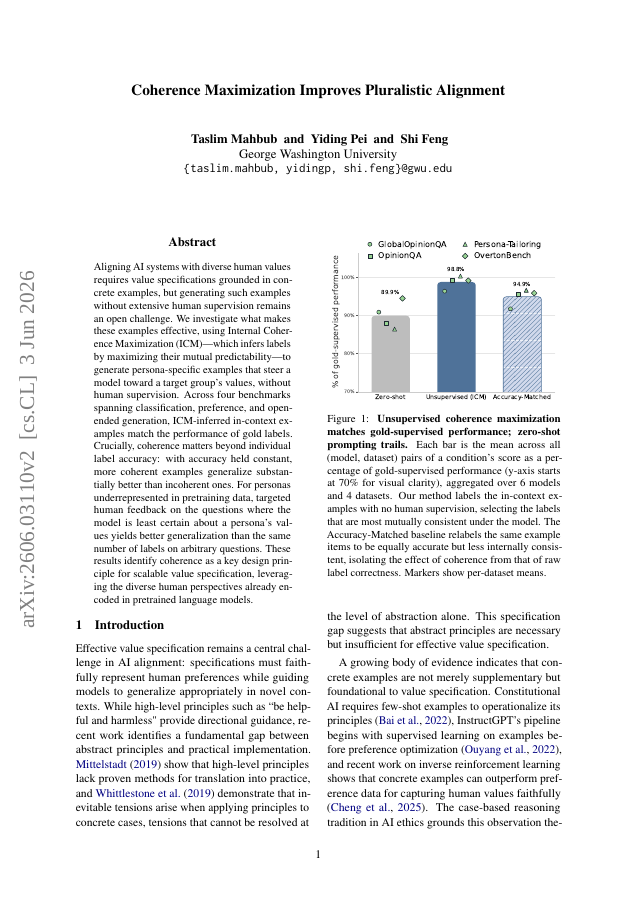
Aligning AI systems with diverse human values requires value specifications grounded in concrete examples, but generating such examples without extensive human supervision remains an open challenge. We investigate what makes these examples effective, using Internal Coherence Maximization (ICM) -- which infers labels by maximizing their mutual predictability -- to generate persona-specific examples that steer a model toward a target group's values, without human supervision. Across four benchmarks spanning classification, preference, and open-ended generation, ICM-inferred in-context examples match the performance of gold labels. Crucially, coherence matters beyond individual label accuracy: with accuracy held constant, more coherent examples generalize substantially better than incoherent ones. For personas underrepresented in pretraining data, targeted human feedback on the questions where the model is least certain about a persona's values yields better generalization than the same number of labels on arbitrary questions. These results identify coherence as a key design principle for scalable value specification, leveraging the diverse human perspectives already encoded in pretrained language models.
Coherence Maximization Improves Pluralistic Alignment
Aligning AI systems with diverse human values requires value specifications grounded in concrete examples, but generating such examples without extensive human supervision remains an open challenge.
- Preview
- Year
- 2026
- Hosting
- Full text hostedCC-BY-4.0
Cite
Notes
Only stored in your browser.
Attribution
- Abstract & full text
- arxiv.org/abs/2606.03110CC-BY-4.0
- TL;DR
- Semantic Scholar