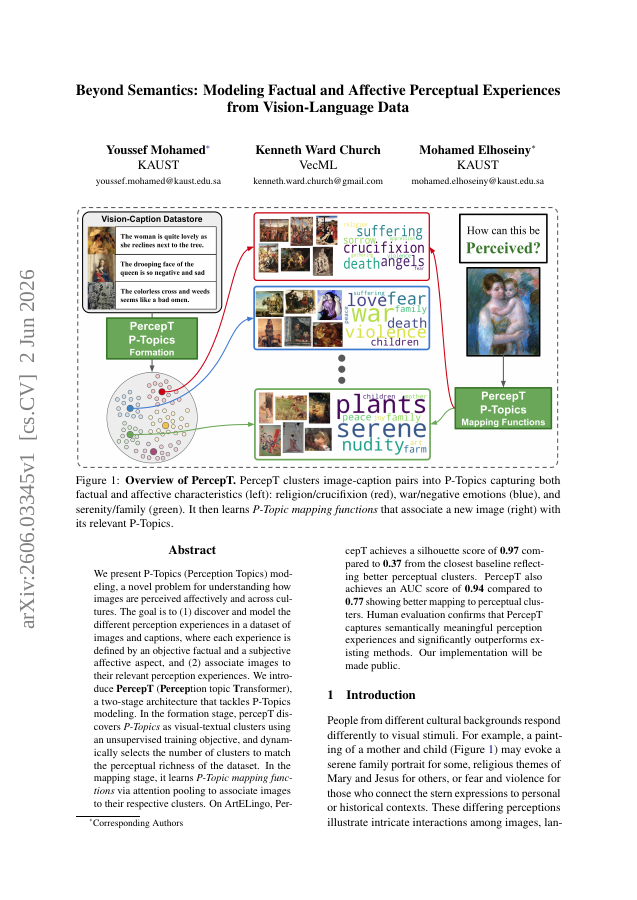
We present P-Topics (Perception Topics) modeling, a novel problem for understanding how images are perceived affectively and across cultures. The goal is to (1) discover and model the different perception experiences in a dataset of images and captions, where each experience is defined by an objective factual and a subjective affective aspect, and (2) associate images to their relevant perception experiences. We introduce PercepT (Perception topic Transformer), a two-stage architecture that tackles P-Topics modeling. In the formation stage, percepT discovers P-Topics as visual-textual clusters using an unsupervised training objective, and dynamically selects the number of clusters to match the perceptual richness of the dataset. In the mapping stage, it learns P-Topic mapping functions via attention pooling to associate images to their respective clusters. On ArtELingo, PercepT achieves a silhouette score of 0.97 compared to 0.37 from the closest baseline reflecting better perceptual clusters. PercepT also achieves an AUC score of 0.94 compared to 0.77 showing better mapping to perceptual clusters. Human evaluation confirms that PercepT captures semantically meaningful perception experiences and significantly outperforms existing methods. Our implementation will be made public.
Beyond Semantics: Modeling Factual and Affective Perceptual Experiences from Vision-Language Data
We present P-Topics (Perception Topics) modeling, a novel problem for understanding how images are perceived affectively and across cultures. The goal is to (1) discover and model the different perception experiences in a dataset of images and captions, where each experience is…
- Preview
- Year
- 2026
- Hosting
- Excerpt onlyCC-BY-NC-SA-4.0
Cite
Notes
Only stored in your browser.
Attribution
- Abstract & full text
- arxiv.org/abs/2606.03345CC-BY-NC-SA-4.0
- TL;DR
- Semantic Scholar