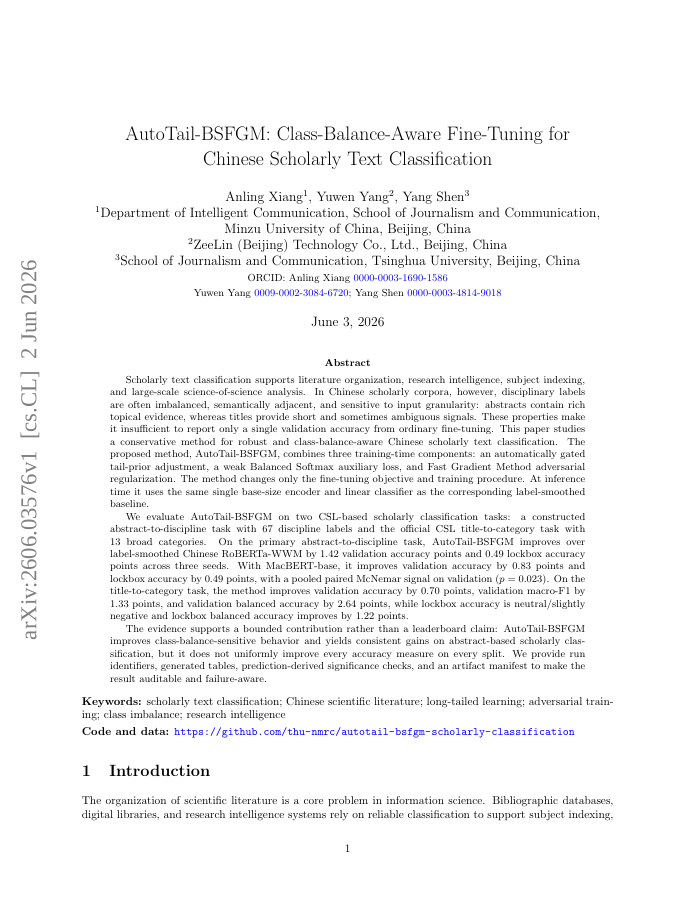
Scholarly text classification supports literature organization, subject indexing, and research intelligence, but Chinese scholarly corpora often contain imbalanced and semantically adjacent disciplinary labels. We propose AutoTail-BSFGM, a class-balance-aware fine-tuning method that combines an automatically gated tail-prior adjustment, a weak Balanced Softmax auxiliary loss, and Fast Gradient Method adversarial regularization. The method changes only the training objective and procedure; inference uses the same single base-size encoder and linear classifier as the corresponding label-smoothed baseline. We evaluate the method on two CSL-based tasks: an abstract-to-discipline task with 67 labels and a title-to-category task with 13 categories. On the primary abstract task, AutoTail-BSFGM improves validation and lockbox accuracy under both Chinese RoBERTa-WWM and MacBERT-base. With MacBERT-base, validation accuracy increases by 0.83 percentage points and lockbox accuracy by 0.49 points, with a pooled paired McNemar signal on validation (p = 0.023). On the title task, the method improves validation accuracy by 0.70 points and validation balanced accuracy by 2.64 points; lockbox accuracy is approximately neutral while lockbox balanced accuracy improves by 1.22 points. The results support a bounded contribution: AutoTail-BSFGM improves class-balance-sensitive behavior and yields consistent gains for abstract-based scholarly classification, without uniformly improving every metric on every split.
AutoTail-BSFGM: Class-Balance-Aware Fine-Tuning for Chinese Scholarly Text Classification
Scholarly text classification supports literature organization, subject indexing, and research intelligence, but Chinese scholarly corpora often contain imbalanced and semantically adjacent disciplinary labels.
- Preview
- Year
- 2026
- Hosting
- Abstract onlyARXIV-DEFAULT
Cite
Notes
Only stored in your browser.
Attribution
- Abstract & full text
- arxiv.org/abs/2606.03576ARXIV-DEFAULT
- TL;DR
- Semantic Scholar