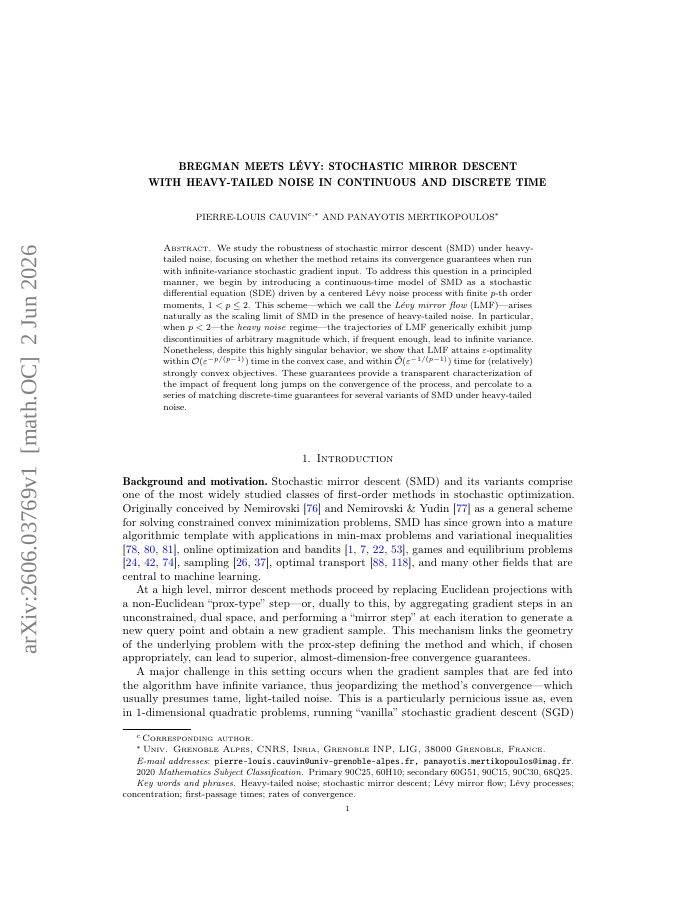
We study the robustness of stochastic mirror descent (SMD) under heavy-tailed noise, focusing on whether the method retains its convergence guarantees when run with infinite-variance stochastic gradient input. To address this question in a principled manner, we begin by introducing a continuous-time model of SMD as a stochastic differential equation (SDE) driven by a centered Lévy noise process with finite p-th order moments, 1 < p \leq 2. This scheme -- which we call the Lévy mirror flow (LMF) -- arises naturally as the scaling limit of SMD in the presence of heavy-tailed noise. In particular, when p < 2 -- the heavy noise regime -- the trajectories of LMF generically exhibit jump discontinuities of arbitrary magnitude which, if frequent enough, lead to infinite variance. Nonetheless, despite this highly singular behavior, we show that LMF attains ε-optimality within O(ε^{-p/(p-1)}) time in the convex case, and within \tilde O(ε^{-1/(p-1)}) time for (relatively) strongly convex objectives. These guarantees provide a transparent characterization of the impact of frequent long jumps on the convergence of the process, and percolate to a series of matching discrete-time guarantees for several variants of SMD under heavy-tailed noise.
Bregman meets Lévy: Stochastic mirror descent with heavy-tailed noise in continuous and discrete time
We study the robustness of stochastic mirror descent (SMD) under heavy-tailed noise, focusing on whether the method retains its convergence guarantees when run with infinite-variance stochastic gradient input.
- Preview
- Year
- 2026
- Hosting
- Full text hostedCC-BY-4.0
Cite
Notes
Only stored in your browser.
Attribution
- Abstract & full text
- arxiv.org/abs/2606.03769CC-BY-4.0
- TL;DR
- Semantic Scholar