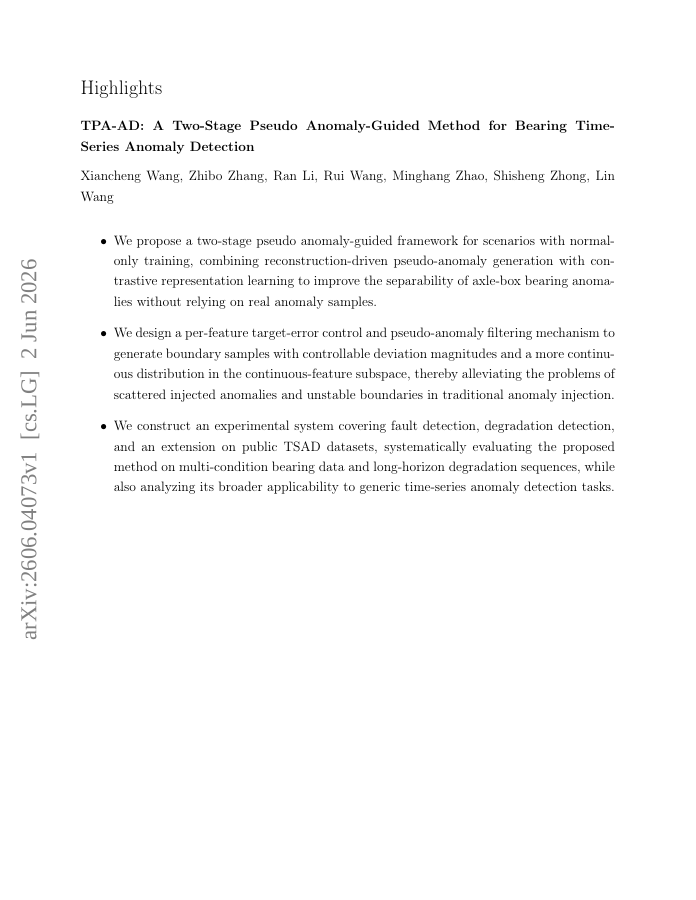
This paper proposes a two-stage pseudo anomaly-guided anomaly detection method (Two-stage Pseudo Anomaly-guided Anomaly Detection, TPA-AD) for axle-box bearing time-series anomaly detection (time series anomaly detection, TSAD) under the setting where only normal samples are available for training. The method first generates pseudo-anomalous windows near the normal boundary using a reconstruction model and per-feature target-error control. It then learns anomaly-sensitive representations through contrastive learning between normal and pseudo-anomalous windows, and finally produces window-level and point-level anomaly scores using k-nearest neighbors (KNN). Compared with existing methods that rely on known fault categories, real anomaly priors, or random anomaly injection, TPA-AD improves the separability of the normal boundary by constructing pseudo-anomalies in boundary neighborhoods and can jointly handle continuous and discrete features in mixed-variable scenarios. The main experiments are conducted on bearing fault detection datasets and degradation-process datasets, with an additional exploratory extension on 13 public TSAD datasets. The results show that the proposed method yields relatively stable anomaly responses, is sensitive to degradation evolution, and demonstrates a certain degree of broader applicability on public TSAD benchmarks and real high-speed-train-related bearing data.
TPA-AD: A Two-Stage Pseudo Anomaly-Guided Method for Bearing Time-Series Anomaly Detection
This paper proposes a two-stage pseudo anomaly-guided anomaly detection method (\textbf{T}wo-stage \textbf{P}seudo \textbf{A}nomaly-guided \textbf{A}nomaly \textbf{D}etection, \textbf{TPA-AD}) for axle-box bearing time-series anomaly detection (time series anomaly detection,…
- Preview
- Year
- 2026
- Hosting
- Abstract onlyARXIV-DEFAULT
Cite
Notes
Only stored in your browser.
Attribution
- Abstract & full text
- arxiv.org/abs/2606.04073ARXIV-DEFAULT
- TL;DR
- Semantic Scholar