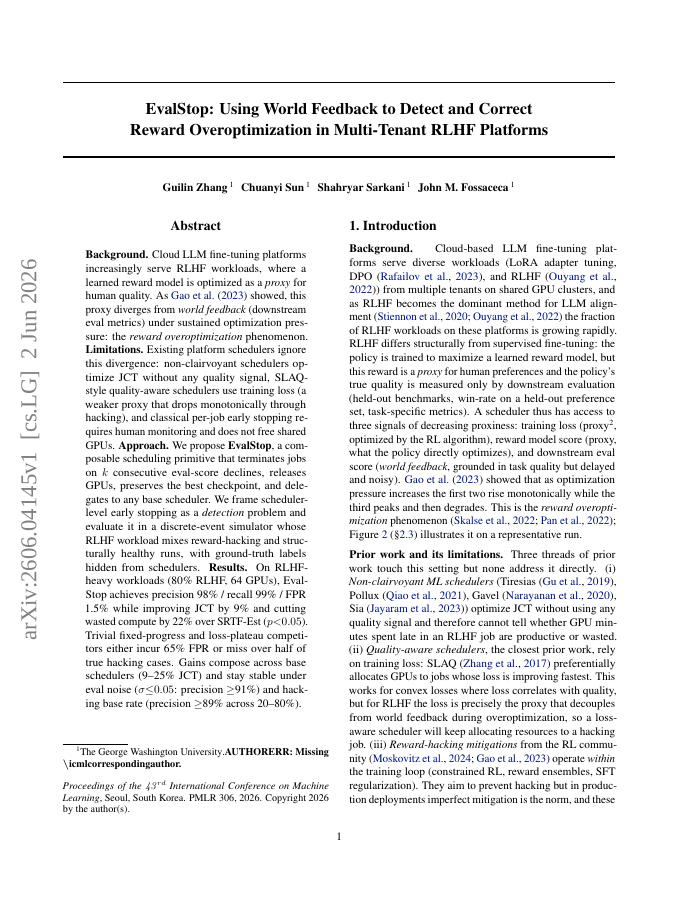
Cloud LLM fine-tuning platforms increasingly serve RLHF workloads, where a learned reward model is optimized as a proxy for human quality. As Gao et al. (2023) showed, this proxy diverges from world feedback (downstream eval metrics) under sustained optimization pressure, a phenomenon known as reward overoptimization. Existing platform schedulers ignore this divergence: non-clairvoyant schedulers optimize JCT without any quality signal, SLAQ-style quality-aware schedulers use training loss (a weaker proxy that drops monotonically through hacking), and classical per-job early stopping requires human monitoring and does not free shared GPUs. We propose EvalStop, a composable scheduling primitive that terminates jobs on k consecutive eval-score declines, releases GPUs, preserves the best checkpoint, and delegates to any base scheduler. We frame scheduler-level early stopping as a detection problem and evaluate it in a discrete-event simulator whose RLHF workload mixes reward-hacking and structurally healthy runs, with ground-truth labels hidden from schedulers. On RLHF-heavy workloads (80% RLHF, 64 GPUs), EvalStop achieves precision 98% / recall 99% / FPR 1.5% while improving JCT by 9% and cutting wasted compute by 22% over SRTF-Est (p<0.05). Trivial fixed-progress and loss-plateau competitors either incur 65% FPR on healthy RLHF or miss over half of true hacking cases. Gains compose across every base scheduler tested (9-25% JCT) and detection quality stays stable under eval noise (precision at least 91% at noise std <= 0.05) and hacking base rate (precision at least 89% across 20-80% hacking fractions).
EvalStop: Using World Feedback to Detect and Correct Reward Overoptimization in Multi-Tenant RLHF Platforms
Cloud LLM fine-tuning platforms increasingly serve RLHF workloads, where a learned reward model is optimized as a proxy for human quality. As Gao et al. (2023) showed, this proxy diverges from world feedback (downstream eval metrics) under sustained optimization pressure, a…
- Preview
- Year
- 2026
- Hosting
- Full text hostedCC-BY-4.0
Cite
Notes
Only stored in your browser.
Attribution
- Abstract & full text
- arxiv.org/abs/2606.04145CC-BY-4.0
- TL;DR
- Semantic Scholar