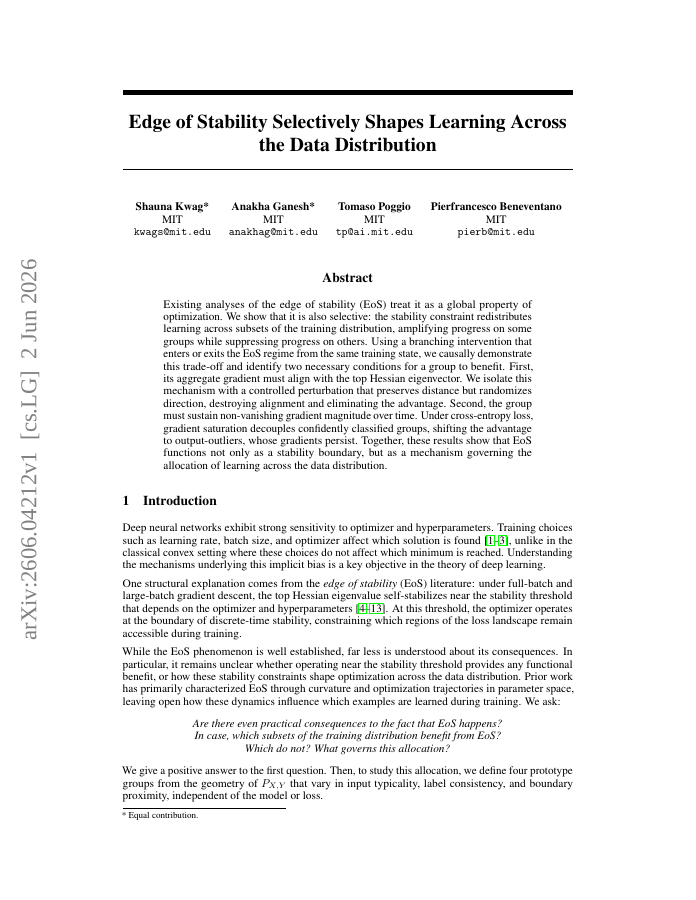
Existing analyses of the edge of stability (EoS) treat it as a global property of optimization. We show that it is also selective: the stability constraint redistributes learning across subsets of the training distribution, amplifying progress on some groups while suppressing progress on others. Using a branching intervention that enters or exits the EoS regime from the same training state, we causally demonstrate this trade-off and identify two necessary conditions for a group to benefit. First, its aggregate gradient must align with the top Hessian eigenvector. We isolate this mechanism with a controlled perturbation that preserves distance but randomizes direction, destroying alignment and eliminating the advantage. Second, the group must sustain non-vanishing gradient magnitude over time. Under cross-entropy loss, gradient saturation decouples confidently classified groups, shifting the advantage to output-outliers, whose gradients persist. Together, these results show that EoS functions not only as a stability boundary, but as a mechanism governing the allocation of learning across the data distribution.
Edge of Stability Selectively Shapes Learning Across the Data Distribution
Existing analyses of the edge of stability (EoS) treat it as a global property of optimization. We show that it is also selective: the stability constraint redistributes learning across subsets of the training distribution, amplifying progress on some groups while suppressing…
- Preview
- Year
- 2026
- Hosting
- Full text hostedCC-BY-4.0
Cite
Notes
Only stored in your browser.
Attribution
- Abstract & full text
- arxiv.org/abs/2606.04212CC-BY-4.0
- TL;DR
- Semantic Scholar