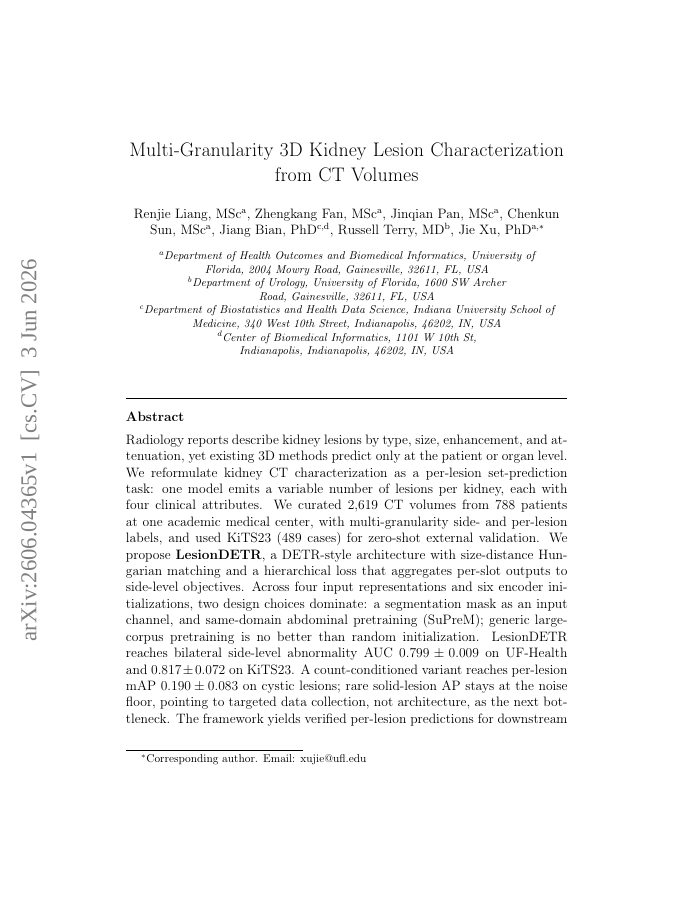
Radiology reports describe kidney lesions by type, size, enhancement, and attenuation, yet existing 3D methods predict only at the patient or organ level. We reformulate kidney CT characterization as a per-lesion set-prediction task: one model emits a variable number of lesions per kidney, each with four clinical attributes. We curated 2,619 CT volumes from 788 patients at one academic medical center, with multi-granularity side- and per-lesion labels, and used KiTS23 (489 cases) for zero-shot external validation. We propose LesionDETR, a DETR-style architecture with size-distance Hungarian matching and a hierarchical loss that aggregates per-slot outputs to side-level objectives. Across four input representations and six encoder initializations, two design choices dominate: a segmentation mask as an input channel, and same-domain abdominal pretraining (SuPreM); generic large-corpus pretraining is no better than random initialization. LesionDETR reaches bilateral side-level abnormality AUC 0.799 \pm 0.009 on UF-Health and 0.817 \pm 0.072 on KiTS23. A count-conditioned variant reaches per-lesion mAP 0.190 \pm 0.083 on cystic lesions; rare solid-lesion AP stays at the noise floor, pointing to targeted data collection, not architecture, as the next bottleneck. The framework yields verified per-lesion predictions for downstream structured report generation.
Multi-Granularity 3D Kidney Lesion Characterization from CT Volumes
Radiology reports describe kidney lesions by type, size, enhancement, and attenuation, yet existing 3D methods predict only at the patient or organ level. We reformulate kidney CT characterization as a per-lesion set-prediction task: one model emits a variable number of lesions…
- Preview
- Year
- 2026
- Hosting
- Full text hostedCC-BY-4.0
Cite
Notes
Only stored in your browser.
Attribution
- Abstract & full text
- arxiv.org/abs/2606.04365CC-BY-4.0
- TL;DR
- Semantic Scholar