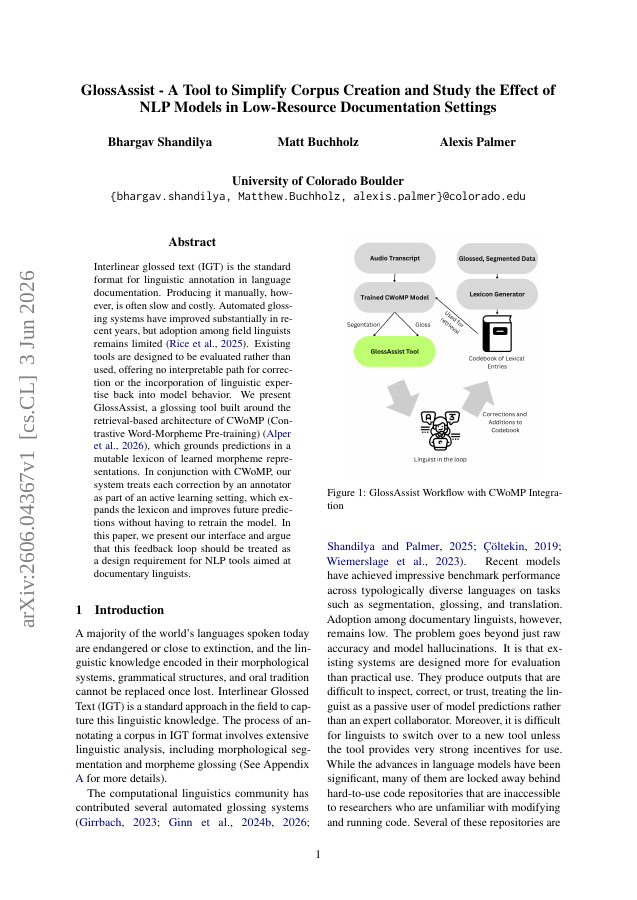
Interlinear glossed text (IGT) is the standard format for linguistic annotation in language documentation. Producing it manually, however, is often slow and costly. Automated glossing systems have improved substantially in recent years, but adoption among field linguists remains limited. Existing tools are designed to be evaluated rather than used, offering no interpretable path for correction or the incorporation of linguistic expertise back into model behavior. We present GlossAssist, a glossing tool built around the retrieval-based architecture of CWoMP (Contrastive Word-Morpheme Pre-training), which grounds predictions in a mutable lexicon of learned morpheme representations. In conjunction with CWoMP, our system treats each correction by an annotator as part of an active learning setting, which expands the lexicon and improves future predictions without having to retrain the model. In this paper, we present our interface and argue that this feedback loop should be treated as a design requirement for NLP tools aimed at documentary linguists.
GlossAssist -- A Tool to Simplify Corpus Creation and Study the Effect of NLP Models in Low-Resource Documentation Settings
Interlinear glossed text (IGT) is the standard format for linguistic annotation in language documentation. Producing it manually, however, is often slow and costly. Automated glossing systems have improved substantially in recent years, but adoption among field linguists remains…
- Preview
- Year
- 2026
- Hosting
- Full text hostedCC-BY-4.0
Cite
Notes
Only stored in your browser.
Attribution
- Abstract & full text
- arxiv.org/abs/2606.04367CC-BY-4.0
- TL;DR
- Semantic Scholar