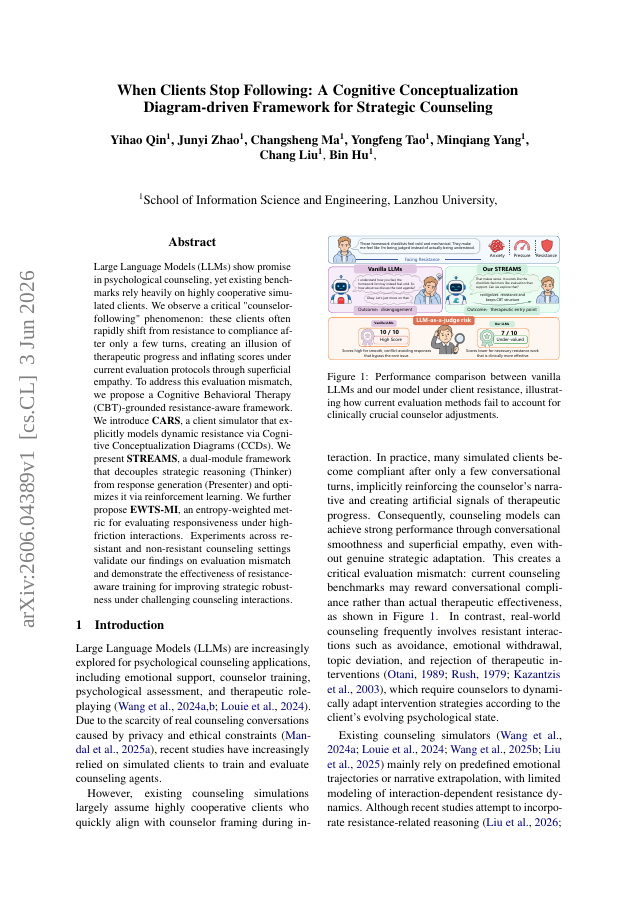
Large Language Models (LLMs) show promise in psychological counseling, yet existing benchmarks rely heavily on highly cooperative simulated clients. We observe a critical counselor-following phenomenon: these clients often rapidly shift from resistance to compliance after only a few turns, creating an illusion of therapeutic progress and inflating scores under current evaluation protocols through superficial empathy. To address this evaluation mismatch, we propose a Cognitive Behavioral Therapy (CBT)-grounded resistance-aware framework. We introduce CARS, a client simulator that explicitly models dynamic resistance via Cognitive Conceptualization Diagrams (CCDs). We present STREAMS, a dual-module framework that decouples strategic reasoning (Thinker) from response generation (Presenter) and optimizes it via reinforcement learning. We further propose EWTS-MI, an entropy-weighted metric for evaluating responsiveness under high-friction interactions. Experiments across resistant and non-resistant counseling settings validate our findings on evaluation mismatch and demonstrate the effectiveness of resistance-aware training for improving strategic robustness under challenging counseling interactions.
When Clients Stop Following: A Cognitive Conceptualization Diagram-driven Framework for Strategic Counseling
Large Language Models (LLMs) show promise in psychological counseling, yet existing benchmarks rely heavily on highly cooperative simulated clients. We observe a critical counselor-following phenomenon: these clients often rapidly shift from resistance to compliance after only a…
- Preview
- Year
- 2026
- Hosting
- Abstract onlyARXIV-DEFAULT
Cite
Notes
Only stored in your browser.
Attribution
- Abstract & full text
- arxiv.org/abs/2606.04389ARXIV-DEFAULT
- TL;DR
- Semantic Scholar