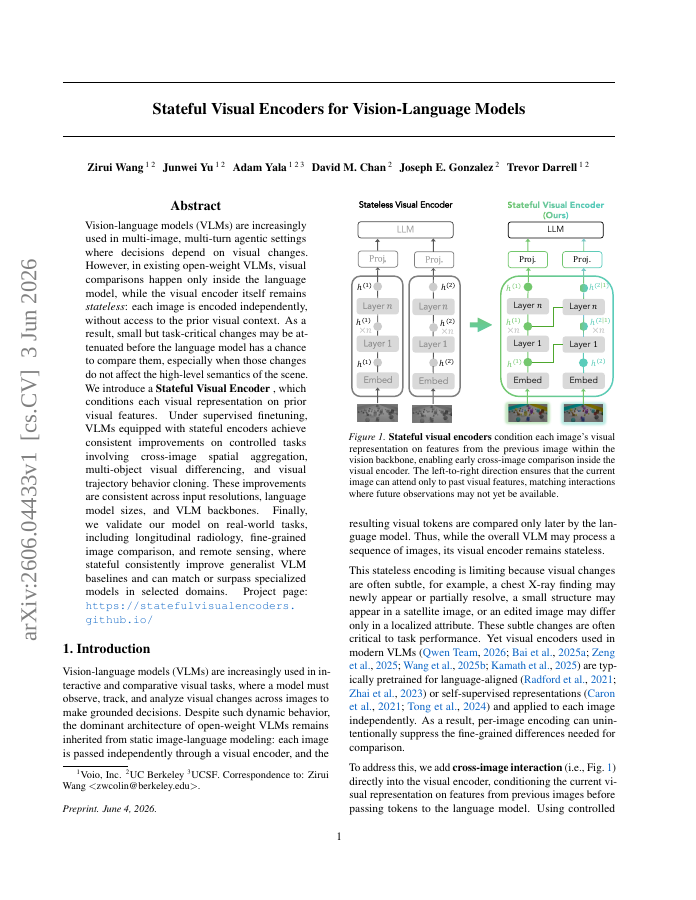
Vision-language models (VLMs) are increasingly used in multi-image, multi-turn agentic settings where decisions depend on visual changes. However, in existing open-weight VLMs, visual comparisons happen only inside the language model, while the visual encoder itself remains stateless: each image is encoded independently, without access to the prior visual context. As a result, small but task-critical changes may be attenuated before the language model has a chance to compare them, especially when those changes do not affect the high-level semantics of the scene. We introduce a Stateful Visual Encoder, which conditions each visual representation on prior visual features. Under supervised finetuning, VLMs equipped with stateful encoders achieve consistent improvements on controlled tasks involving cross-image spatial aggregation, multi-object visual differencing, and visual trajectory behavior cloning. These improvements are consistent across input resolutions, language model sizes, and VLM backbones. Finally, we validate our model on real-world tasks, including longitudinal radiology, fine-grained image comparison, and remote sensing, where stateful encoders consistently improve generalist VLM baselines and can match or surpass specialized models in selected domains. Project page: https://statefulvisualencoders.github.io/
Stateful Visual Encoders for Vision-Language Models
Vision-language models (VLMs) are increasingly used in multi-image, multi-turn agentic settings where decisions depend on visual changes. However, in existing open-weight VLMs, visual comparisons happen only inside the language model, while the visual encoder itself remains…
- Preview
- Year
- 2026
- Hosting
- Full text hostedCC-BY-SA-4.0
Cite
Notes
Only stored in your browser.
Attribution
- Abstract & full text
- arxiv.org/abs/2606.04433CC-BY-SA-4.0
- TL;DR
- Semantic Scholar