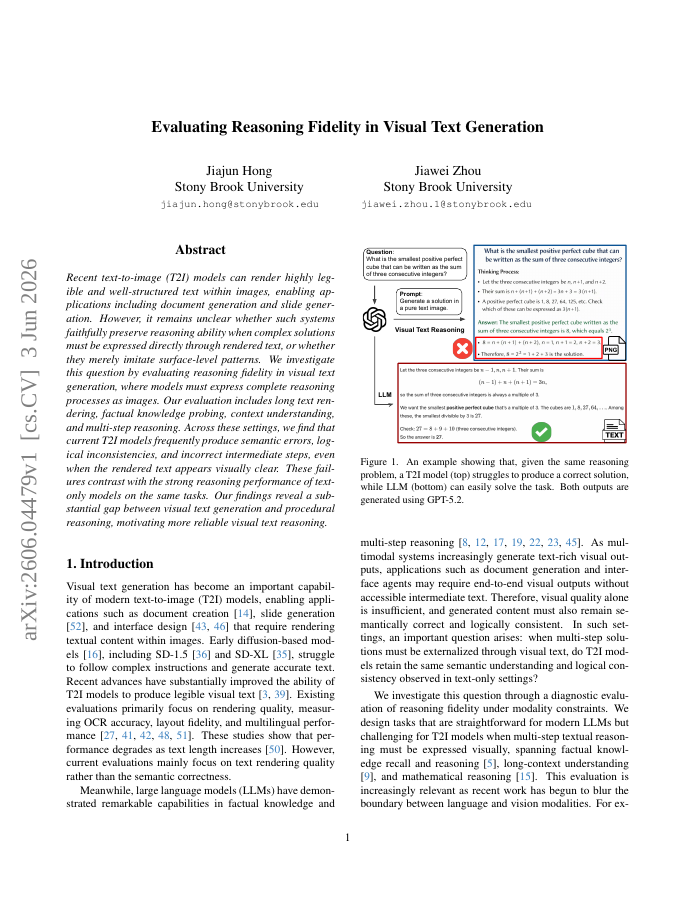
Recent text-to-image (T2I) models can render highly legible and well-structured text within images, enabling applications including document generation and slide generation. However, it remains unclear whether such systems faithfully preserve reasoning ability when complex solutions must be expressed directly through rendered text, or whether they merely imitate surface-level patterns. We investigate this question by evaluating reasoning fidelity in visual text generation, where models must express complete reasoning processes as images. Our evaluation includes long text rendering, factual knowledge probing, context understanding, and multi-step reasoning. Across these settings, we find that current T2I models frequently produce semantic errors, logical inconsistencies, and incorrect intermediate steps, even when the rendered text appears visually clear. These failures contrast with the strong reasoning performance of text-only models on the same tasks. Our findings reveal a substantial gap between visual text generation and procedural reasoning, motivating more reliable visual text reasoning.
Evaluating Reasoning Fidelity in Visual Text Generation
Recent text-to-image (T2I) models can render highly legible and well-structured text within images, enabling applications including document generation and slide generation.
- Preview
- Year
- 2026
- Hosting
- Full text hostedCC-BY-4.0
Cite
Notes
Only stored in your browser.
Attribution
- Abstract & full text
- arxiv.org/abs/2606.04479CC-BY-4.0
- TL;DR
- Semantic Scholar