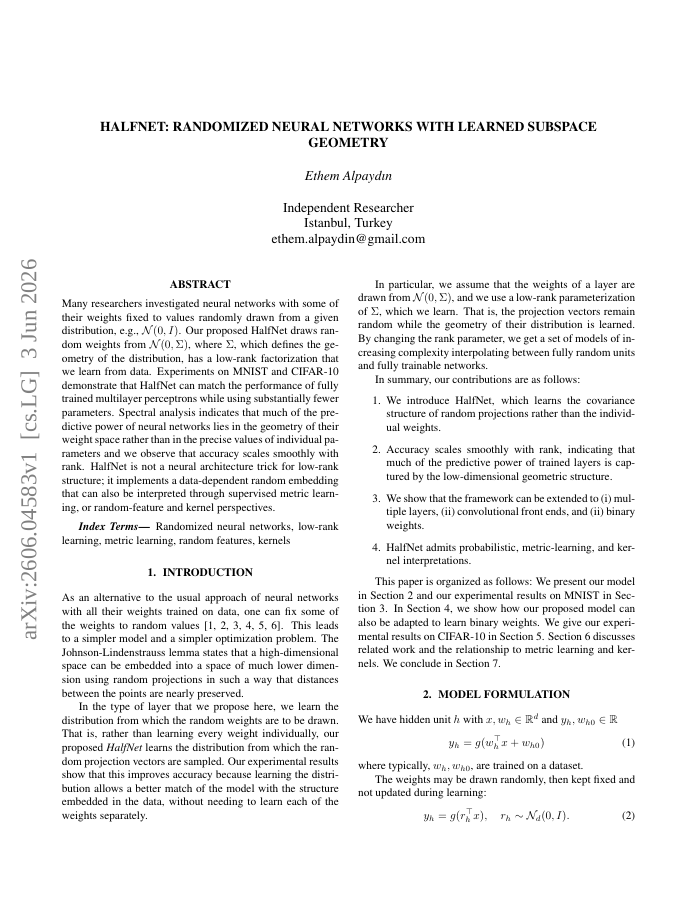
Many researchers investigated neural networks with some of their weights fixed to values randomly drawn from a given distribution, e.g., N(0, I). Our proposed HalfNet draws random weights from N(0, Σ), where Σ, which defines the geometry of the distribution, has a low-rank factorization that we learn from data. Experiments on MNIST and CIFAR-10 demonstrate that HalfNet can match the performance of fully trained multilayer perceptrons while using substantially fewer parameters. Spectral analysis indicates that much of the predictive power of neural networks lies in the geometry of their weight space rather than in the precise values of individual parameters, and we observe that accuracy scales smoothly with rank. HalfNet is not a neural architecture trick for low-rank structure; it implements a data-dependent random embedding that can also be interpreted through supervised metric learning, or random-feature and kernel perspectives.
HalfNet: Randomized Neural Networks with Learned Subspace Geometry
Many researchers investigated neural networks with some of their weights fixed to values randomly drawn from a given distribution, e.g., $N(0, I)$. Our proposed HalfNet draws random weights from $N(0, Σ)$, where $Σ$, which defines the geometry of the distribution, has a low-rank…
- Preview
- Year
- 2026
- Hosting
- Full text hostedCC-BY-4.0
Cite
Notes
Only stored in your browser.
Attribution
- Abstract & full text
- arxiv.org/abs/2606.04583CC-BY-4.0
- TL;DR
- Semantic Scholar