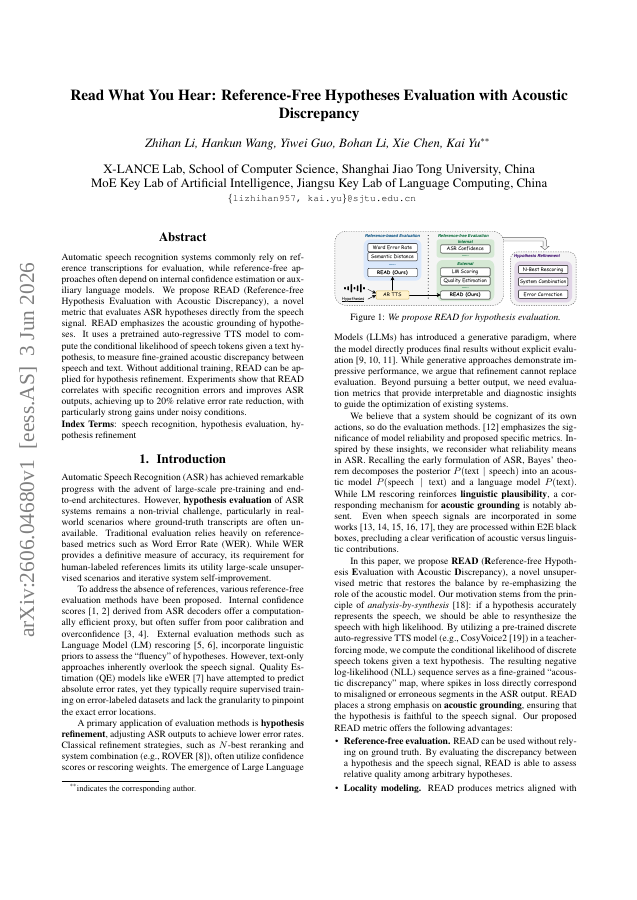
Automatic speech recognition systems commonly rely on reference transcriptions for evaluation, while reference-free approaches often depend on internal confidence estimation or auxiliary language models. We propose READ (Reference-free Hypothesis Evaluation with Acoustic Discrepancy), a novel metric that evaluates ASR hypotheses directly from the speech signal. READ emphasizes the acoustic grounding of hypotheses. It uses a pretrained auto-regressive TTS model to compute the conditional likelihood of speech tokens given a text hypothesis, to measure fine-grained acoustic discrepancy between speech and text. Without additional training, READ can be applied for hypothesis refinement. Experiments show that READ correlates with specific recognition errors and improves ASR outputs, achieving up to 20% relative error rate reduction, with particularly strong gains under noisy conditions.
Read What You Hear: Reference-Free Hypotheses Evaluation with Acoustic Discrepancy
Automatic speech recognition systems commonly rely on reference transcriptions for evaluation, while reference-free approaches often depend on internal confidence estimation or auxiliary language models.
- Preview
- Year
- 2026
- Hosting
- Abstract onlyARXIV-DEFAULT
Cite
Notes
Only stored in your browser.
Attribution
- Abstract & full text
- arxiv.org/abs/2606.04680ARXIV-DEFAULT
- TL;DR
- Semantic Scholar