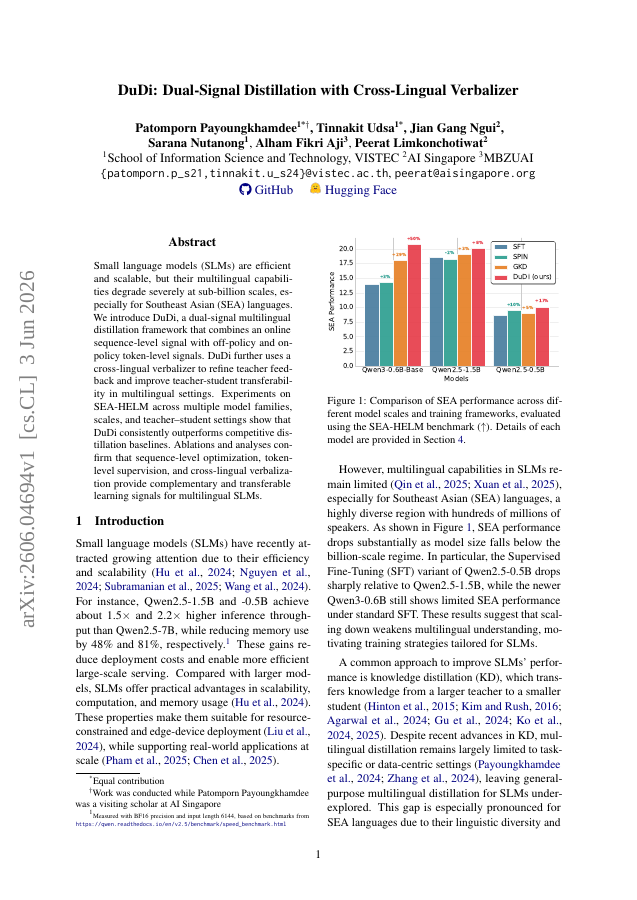
Small language models (SLMs) are efficient and scalable, but their multilingual capabilities degrade severely at sub-billion scales, especially for Southeast Asian (SEA) languages. We introduce DuDi, a dual-signal multilingual distillation framework that combines an online sequence-level signal with off-policy and on-policy token-level signals. DuDi further uses a cross-lingual verbalizer to refine teacher feedback and improve teacher-student transferability in multilingual settings. Experiments on SEA-HELM across multiple model families, scales, and teacher-student settings show that DuDi consistently outperforms competitive distillation baselines. Ablations and analyses confirm that sequence-level optimization, token-level supervision, and cross-lingual verbalization provide complementary and transferable learning signals for multilingual SLMs.
DuDi: Dual-Signal Distillation with Cross-Lingual Verbalizer
Small language models (SLMs) are efficient and scalable, but their multilingual capabilities degrade severely at sub-billion scales, especially for Southeast Asian (SEA) languages.
- Preview
- Year
- 2026
- Hosting
- Full text hostedCC-BY-4.0
Cite
Notes
Only stored in your browser.
Attribution
- Abstract & full text
- arxiv.org/abs/2606.04694CC-BY-4.0
- TL;DR
- Semantic Scholar