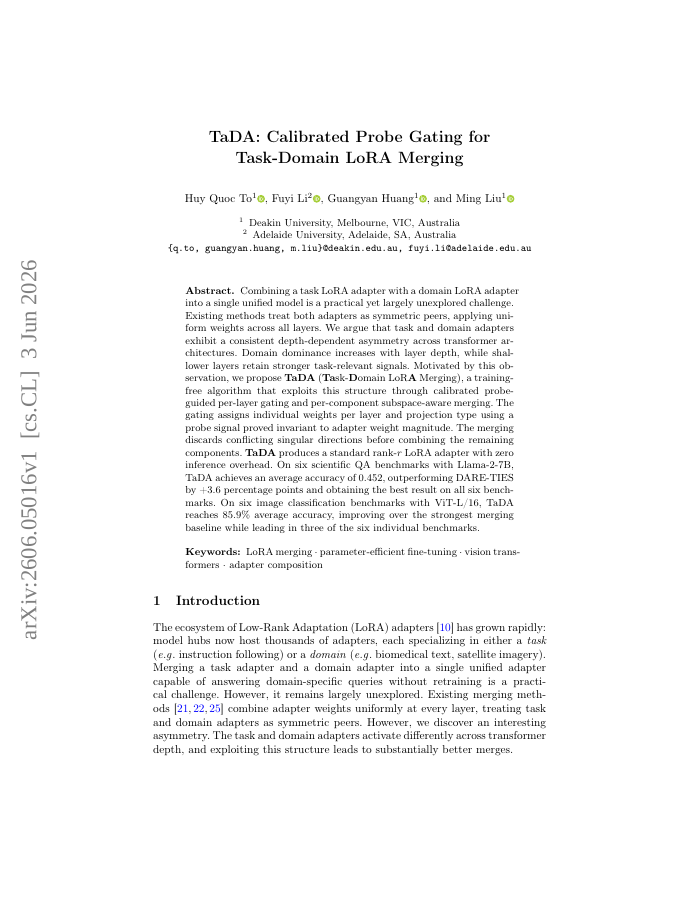
Combining a task LoRA adapter with a domain LoRA adapter into a single unified model is a practical yet largely unexplored challenge. Existing methods treat both adapters as symmetric peers, applying uniform weights across all layers. We argue that task and domain adapters exhibit a consistent depth-dependent asymmetry across transformer architectures. Domain dominance increases with layer depth, while shallower layers retain stronger task-relevant signals. Motivated by this observation, we propose TaDA (Task-Domain LoRA Merging), a training-free algorithm that exploits this structure through calibrated probe-guided per-layer gating and per-component subspace-aware merging. The gating assigns individual weights per layer and projection type using a probe signal proved invariant to adapter weight magnitude. The merging discards conflicting singular directions before combining the remaining components. TaDA produces a standard rank-r LoRA adapter with zero inference overhead. On six scientific QA benchmarks with Llama-2-7B, TaDA achieves an average accuracy of 0.452, outperforming DARE-TIES by +3.6 percentage points and obtaining the best result on all six benchmarks. On six image classification benchmarks with ViT-L/16, TaDA reaches 85.9% average accuracy, improving over the strongest merging baseline while leading in three of the six individual benchmarks.
TaDA: Calibrated Probe Gating for Task-Domain LoRA Merging
Combining a task LoRA adapter with a domain LoRA adapter into a single unified model is a practical yet largely unexplored challenge. Existing methods treat both adapters as symmetric peers, applying uniform weights across all layers.
- Preview
- Year
- 2026
- Hosting
- Excerpt onlyCC-BY-NC-SA-4.0
Cite
Notes
Only stored in your browser.
Attribution
- Abstract & full text
- arxiv.org/abs/2606.05016CC-BY-NC-SA-4.0
- TL;DR
- Semantic Scholar