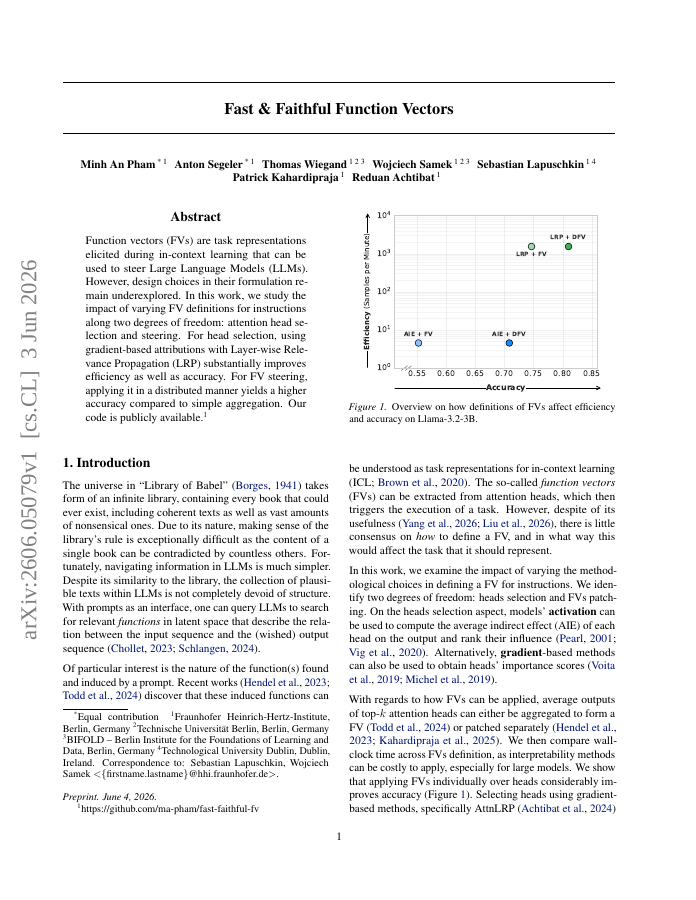
Function vectors (FVs) are task representations elicited during in-context learning that can be used to steer Large Language Models (LLMs). However, design choices in their formulation remain underexplored. In this work, we study the impact of varying FV definitions for instructions along two degrees of freedom: attention head selection and steering. For head selection, using gradient-based attributions with Layer-wise Relevance Propagation (LRP) substantially improves efficiency as well as accuracy. For FV steering, applying it in a distributed manner yields a higher accuracy compared to simple aggregation. Our code is publicly available.
Fast & Faithful Function Vectors
Function vectors (FVs) are task representations elicited during in-context learning that can be used to steer Large Language Models (LLMs). However, design choices in their formulation remain underexplored.
- Preview
- Year
- 2026
- Hosting
- Excerpt onlyCC-BY-NC-SA-4.0
Cite
Notes
Only stored in your browser.
Attribution
- Abstract & full text
- arxiv.org/abs/2606.05079CC-BY-NC-SA-4.0
- TL;DR
- Semantic Scholar