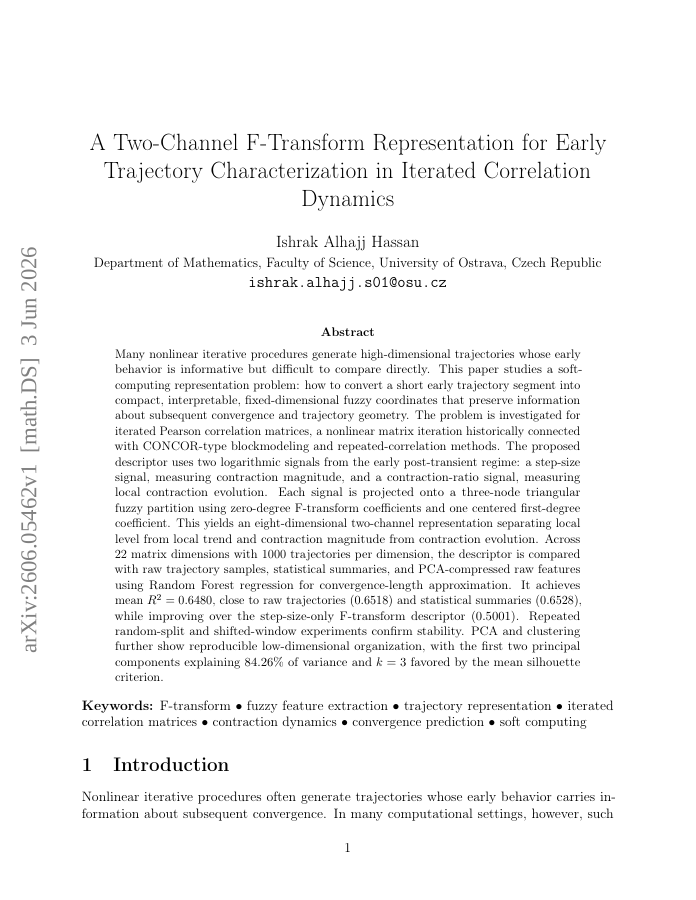
Many nonlinear iterative procedures generate high-dimensional trajectories whose early behavior is informative but difficult to compare directly. This paper studies a soft-computing representation problem: how to convert a short early trajectory segment into compact, interpretable, fixed-dimensional fuzzy coordinates that preserve information about subsequent convergence and trajectory geometry. The problem is investigated for iterated Pearson correlation matrices, a nonlinear matrix iteration historically connected with CONCOR-type blockmodeling and repeated-correlation methods. The proposed descriptor uses two logarithmic signals from the early post-transient regime: a step-size signal, measuring contraction magnitude, and a contraction-ratio signal, measuring local contraction evolution. Each signal is projected onto a three-node triangular fuzzy partition using zero-degree F-transform coefficients and one centered first-degree coefficient. This yields an eight-dimensional two-channel representation separating local level from local trend and contraction magnitude from contraction evolution. Across 22 matrix dimensions with 1000 trajectories per dimension, the descriptor is compared with raw trajectory samples, statistical summaries, and PCA-compressed raw features using Random Forest regression for convergence-length approximation. It achieves mean R^2 = 0.6480, close to raw trajectories (0.6518) and statistical summaries (0.6528), while improving over the step-size-only F-transform descriptor (0.5001). Repeated random-split and shifted-window experiments confirm stability. PCA and clustering further show reproducible low-dimensional organization, with the first two principal components explaining 84.26% of variance and k = 3 favored by the mean silhouette criterion.
A Two-Channel F-Transform Representation for Early Trajectory Characterization in Iterated Correlation Dynamics
Many nonlinear iterative procedures generate high-dimensional trajectories whose early behavior is informative but difficult to compare directly. This paper studies a soft-computing representation problem: how to convert a short early trajectory segment into compact,…
- Preview
- Year
- 2026
- Hosting
- Abstract onlyARXIV-DEFAULT
Cite
Notes
Only stored in your browser.
Attribution
- Abstract & full text
- arxiv.org/abs/2606.05462ARXIV-DEFAULT
- TL;DR
- Semantic Scholar