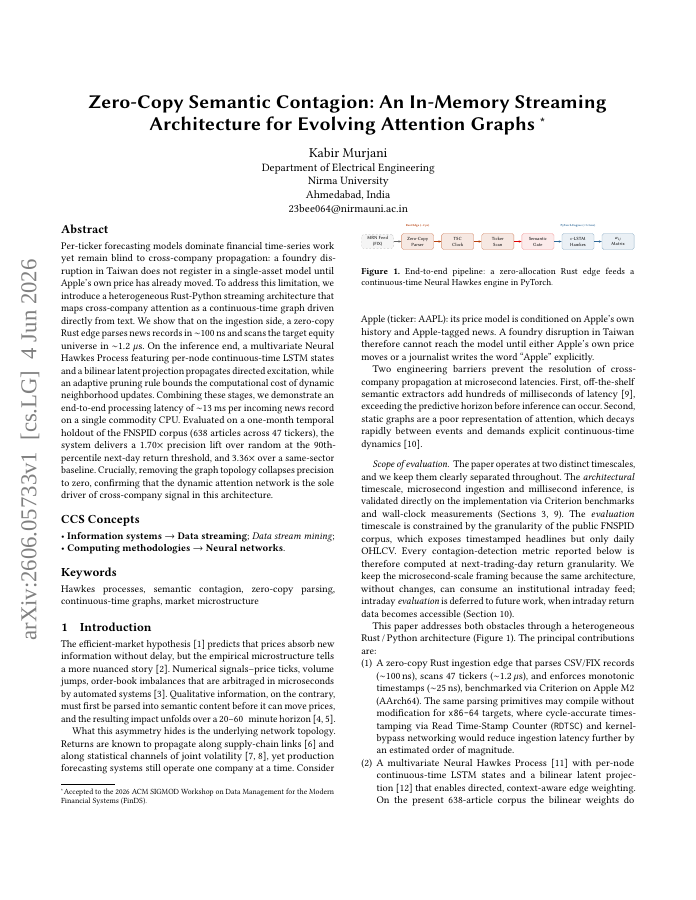
Per-ticker forecasting models dominate financial time-series work yet remain blind to cross-company propagation: a foundry disruption in Taiwan does not register in a single-asset model until Apple's own price has already moved. To address this limitation, we introduce a heterogeneous Rust-Python streaming architecture that maps cross-company attention as a continuous-time graph driven directly from text. We show that on the ingestion side, a zero-copy Rust edge parses news records in \sim100 ns and scans the target equity universe in \sim1.2 μs. On the inference end, a multivariate Neural Hawkes Process featuring per-node continuous-time LSTM states and a bilinear latent projection propagates directed excitation, while an adaptive pruning rule bounds the computational cost of dynamic neighborhood updates. Combining these stages, we demonstrate an end-to-end processing latency of \sim13 ms per incoming news record on a single commodity CPU. Evaluated on a one-month temporal holdout of the FNSPID corpus (638 articles across 47 tickers), the system delivers a 1.70\times precision lift over random at the 90th-percentile next-day return threshold, and 3.36\times over a same-sector baseline. Crucially, removing the graph topology collapses precision to zero, confirming that the dynamic attention network is the sole driver of cross-company signal in this architecture.
Zero-Copy Semantic Contagion: An In-Memory Streaming Architecture for Evolving Attention Graphs
Per-ticker forecasting models dominate financial time-series work yet remain blind to cross-company propagation: a foundry disruption in Taiwan does not register in a single-asset model until Apple's own price has already moved.
- Preview
- Year
- 2026
- Hosting
- Full text hostedCC-BY-4.0
Cite
Notes
Only stored in your browser.
Attribution
- Abstract & full text
- arxiv.org/abs/2606.05733CC-BY-4.0
- TL;DR
- Semantic Scholar