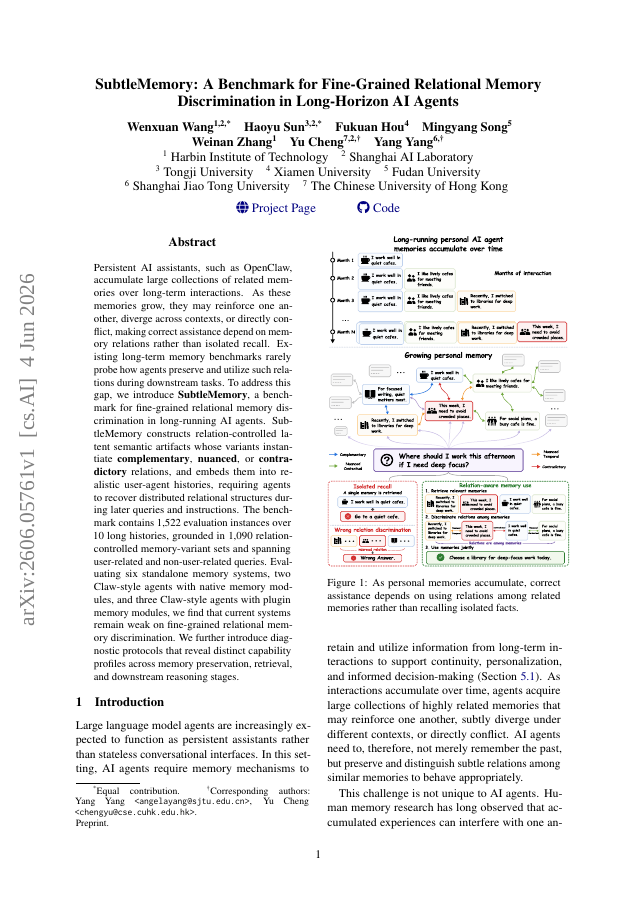
Persistent AI assistants, such as OpenClaw, accumulate large collections of related memories over long-term interactions. As these memories grow, they may reinforce one another, diverge across contexts, or directly conflict, making correct assistance depend on memory relations rather than isolated recall. Existing long-term memory benchmarks rarely probe how agents preserve and utilize such relations during downstream tasks. To address this gap, we introduce SubtleMemory, a benchmark for fine-grained relational memory discrimination in long-running AI agents. SubtleMemory constructs relation-controlled latent semantic artifacts whose variants instantiate complementary, nuanced, or contradictory relations, and embeds them into realistic user-agent histories, requiring agents to recover distributed relational structures during later queries and instructions. The benchmark contains 1,522 evaluation instances over 10 long histories, grounded in 1,090 relation-controlled memory-variant sets and spanning user-related and non-user-related queries. Evaluating six standalone memory systems, two Claw-style agents with native memory modules, and three Claw-style agents with plugin memory modules, we find that current systems remain weak on fine-grained relational memory discrimination. We further introduce diagnostic protocols that reveal distinct capability profiles across memory preservation, retrieval, and downstream reasoning stages.
SubtleMemory: A Benchmark for Fine-Grained Relational Memory Discrimination in Long-Horizon AI Agents
Persistent AI assistants, such as OpenClaw, accumulate large collections of related memories over long-term interactions. As these memories grow, they may reinforce one another, diverge across contexts, or directly conflict, making correct assistance depend on memory relations…
- Preview
- Year
- 2026
- Hosting
- Full text hostedCC-BY-4.0
Cite
Notes
Only stored in your browser.
Attribution
- Abstract & full text
- arxiv.org/abs/2606.05761CC-BY-4.0
- TL;DR
- Semantic Scholar