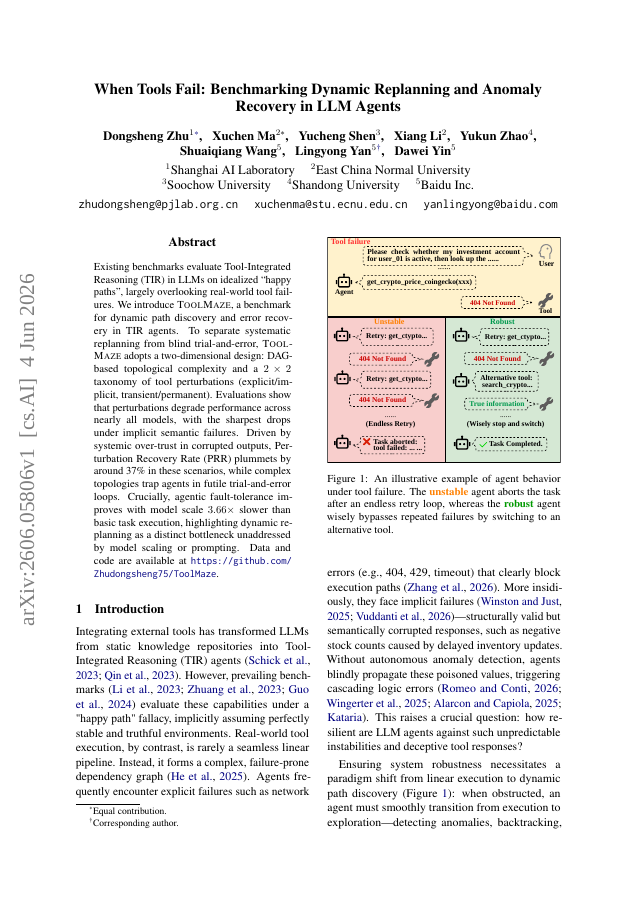
Existing benchmarks evaluate Tool-Integrated Reasoning (TIR) in LLMs on idealized ''happy paths'', largely overlooking real-world tool failures. We introduce ToolMaze, a benchmark for dynamic path discovery and error recovery in TIR agents. To separate systematic replanning from blind trial-and-error, ToolMaze adopts a two-dimensional design: DAG-based topological complexity and a 2 \times 2 taxonomy of tool perturbations (explicit/implicit, transient/permanent). Evaluations show that perturbations degrade performance across nearly all models, with the sharpest drops under implicit semantic failures. Driven by systemic over-trust in corrupted outputs, Perturbation Recovery Rate (PRR) plummets by around 37% in these scenarios, while complex topologies trap agents in futile trial-and-error loops. Crucially, agentic fault-tolerance improves with model scale 3.66\times slower than basic task execution, highlighting dynamic replanning as a distinct bottleneck unaddressed by model scaling or prompting. Data and code are available at https://github.com/Zhudongsheng75/ToolMaze.
When Tools Fail: Benchmarking Dynamic Replanning and Anomaly Recovery in LLM Agents
Existing benchmarks evaluate Tool-Integrated Reasoning (TIR) in LLMs on idealized ''happy paths'', largely overlooking real-world tool failures. We introduce ToolMaze, a benchmark for dynamic path discovery and error recovery in TIR agents.
- Preview
- Year
- 2026
- Hosting
- Full text hostedCC-BY-4.0
Cite
Notes
Only stored in your browser.
Attribution
- Abstract & full text
- arxiv.org/abs/2606.05806CC-BY-4.0
- TL;DR
- Semantic Scholar