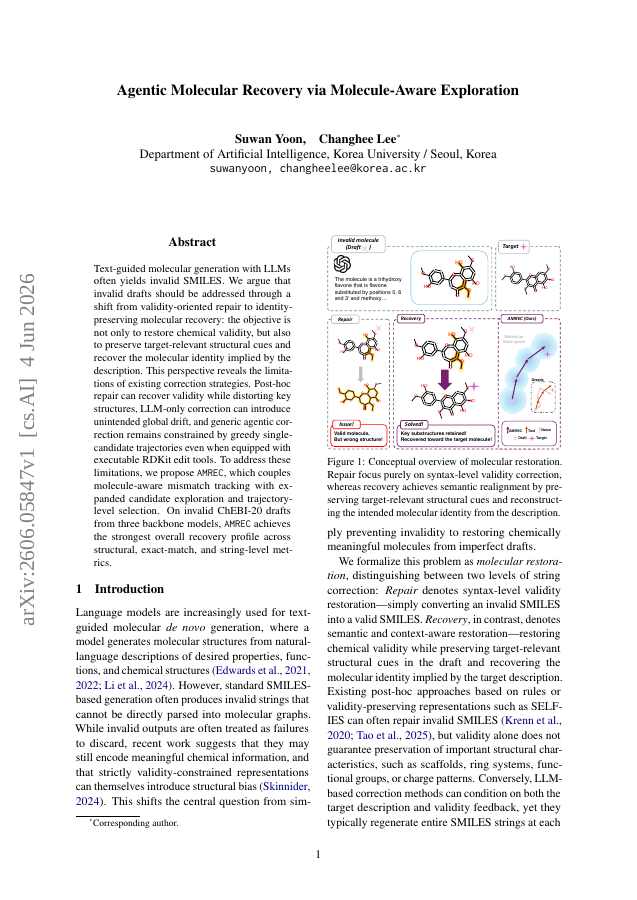
Text-guided molecular generation with LLMs often yields invalid SMILES. We argue that invalid drafts should be addressed through a shift from validity-oriented repair to identity-preserving molecular recovery: the objective is not only to restore chemical validity, but also to preserve target-relevant structural cues and recover the molecular identity implied by the description. This perspective reveals the limitations of existing correction strategies. Post-hoc repair can recover validity while distorting key structures, LLM-only correction can introduce unintended global drift, and generic agentic correction remains constrained by greedy single-candidate trajectories even when equipped with executable RDKit edit tools. To address these limitations, we propose AMREC, which couples molecule-aware mismatch tracking with expanded candidate exploration and trajectory-level selection. On invalid ChEBI-20 drafts from three backbone models, AMREC achieves the strongest overall recovery profile across structural, exact-match, and string-level metrics.
Agentic Molecular Recovery via Molecule-Aware Exploration
Text-guided molecular generation with LLMs often yields invalid SMILES. We argue that invalid drafts should be addressed through a shift from validity-oriented repair to identity-preserving molecular recovery: the objective is not only to restore chemical validity, but also to…
- Preview
- Year
- 2026
- Hosting
- Excerpt onlyCC-BY-NC-4.0
Cite
Notes
Only stored in your browser.
Attribution
- Abstract & full text
- arxiv.org/abs/2606.05847CC-BY-NC-4.0
- TL;DR
- Semantic Scholar