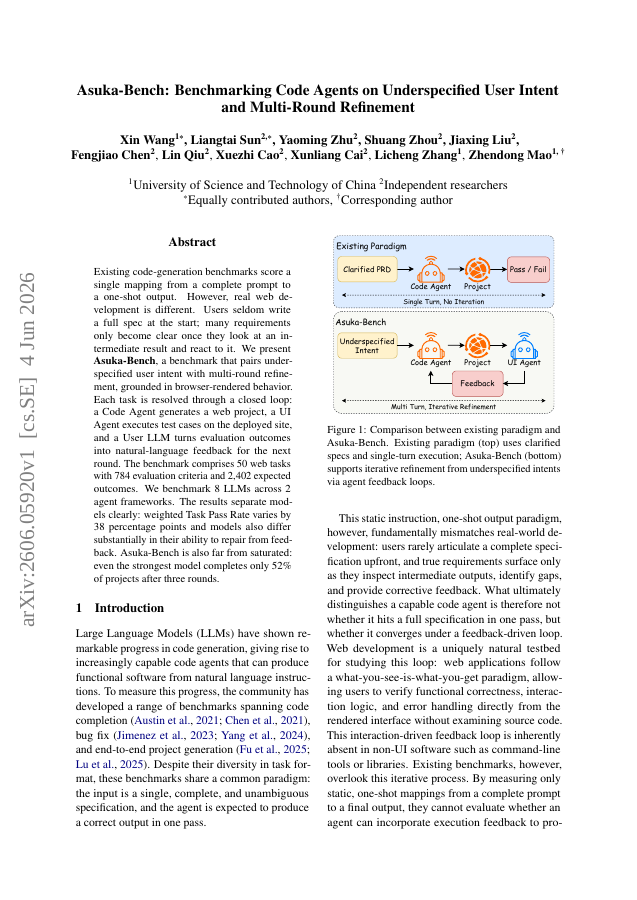
Existing code-generation benchmarks score a single mapping from a complete prompt to a one-shot output. However, real web development is different. Users seldom write a full spec at the start; many requirements only become clear once they look at an intermediate result and react to it. We present Asuka-Bench, a benchmark that pairs underspecified user intent with multi-round refinement, grounded in browser-rendered behavior. Each task is resolved through a closed loop: a Code Agent generates a web project, a UI Agent executes test cases on the deployed site, and a User LLM turns evaluation outcomes into natural-language feedback for the next round. The benchmark comprises 50 web tasks with 784 evaluation criteria and 2402 expected outcomes. We benchmark 8 LLMs across 2 agent frameworks. The results separate models clearly: weighted Task Pass Rate varies by 38 percentage points and models also differ substantially in their ability to repair from feedback. Asuka-Bench is also far from saturated: even the strongest model completes only 52% of projects after three rounds.
Asuka-Bench: Benchmarking Code Agents on Underspecified User Intent and Multi-Round Refinement
Existing code-generation benchmarks score a single mapping from a complete prompt to a one-shot output. However, real web development is different. Users seldom write a full spec at the start; many requirements only become clear once they look at an intermediate result and react…
- Preview
- Year
- 2026
- Hosting
- Full text hostedCC-BY-4.0
Cite
Notes
Only stored in your browser.
Attribution
- Abstract & full text
- arxiv.org/abs/2606.05920CC-BY-4.0
- TL;DR
- Semantic Scholar