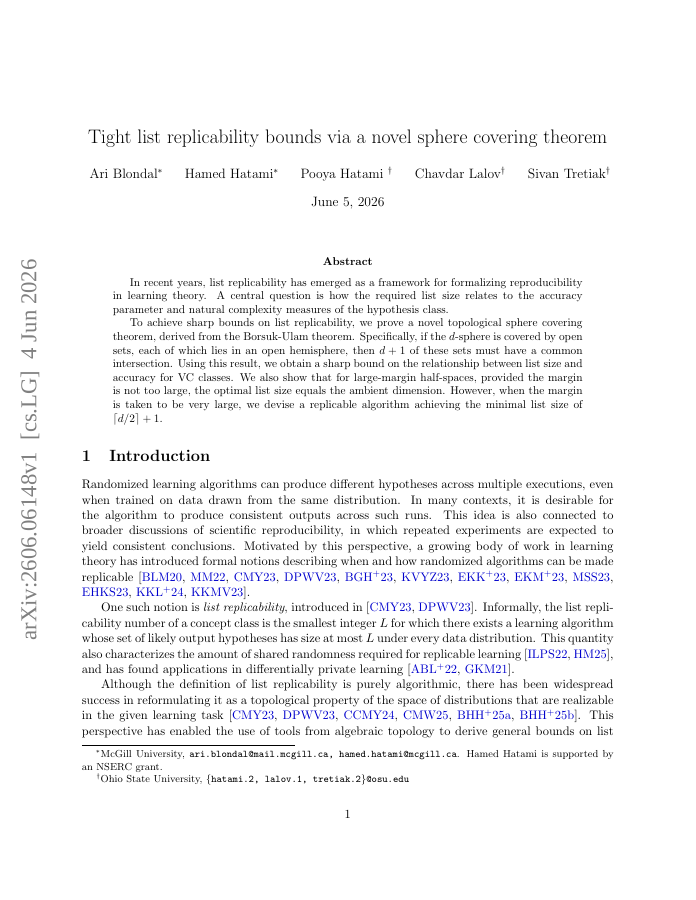
In recent years, list replicability has emerged as a framework for formalizing reproducibility in learning theory. A central question is how the required list size relates to the accuracy parameter and natural complexity measures of the hypothesis class. To achieve sharp bounds on list replicability, we prove a novel topological sphere covering theorem, derived from the Borsuk-Ulam theorem. Specifically, if the d-sphere is covered by open sets, each of which lies in an open hemisphere, then d+1 of these sets must have a common intersection. Using this result, we obtain a sharp bound on the relationship between list size and accuracy for VC classes. We also show that for large-margin half-spaces, provided the margin is not too large, the optimal list size equals the ambient dimension. However, when the margin is taken to be very large, we devise a replicable algorithm achieving the minimal list size of \lceil d/2 \rceil + 1.
Tight list replicability bounds via a novel sphere covering theorem
In recent years, list replicability has emerged as a framework for formalizing reproducibility in learning theory. A central question is how the required list size relates to the accuracy parameter and natural complexity measures of the hypothesis class.
- Preview
- Year
- 2026
- Hosting
- Abstract onlyARXIV-DEFAULT
Cite
Notes
Only stored in your browser.
Attribution
- Abstract & full text
- arxiv.org/abs/2606.06148ARXIV-DEFAULT
- TL;DR
- Semantic Scholar