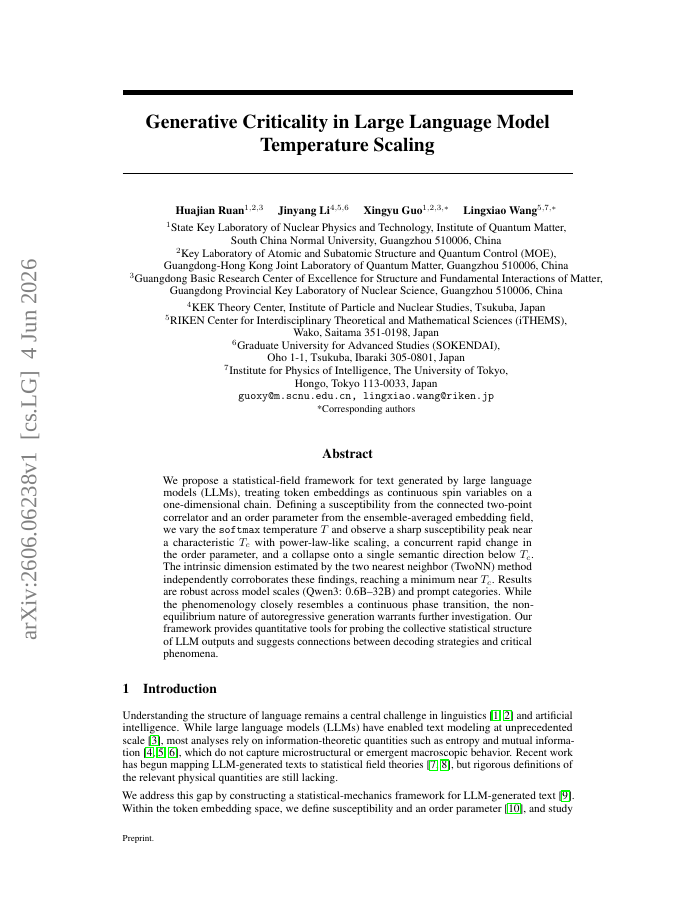
We propose a statistical-field framework for text generated by large language models (LLMs), treating token embeddings as continuous spin variables on a one-dimensional chain. Defining a susceptibility from the connected two-point correlator and an order parameter from the ensemble-averaged embedding field, we vary the softmax temperature T and observe a sharp susceptibility peak near a characteristic T_c with power-law-like scaling, a concurrent rapid change in the order parameter, and a collapse onto a single semantic direction below T_c. The intrinsic dimension estimated by the two nearest neighbor (TwoNN) method independently corroborates these findings, reaching a minimum near T_c. Results are robust across model scales (Qwen3: 0.6B--32B) and prompt categories. While the phenomenology closely resembles a continuous phase transition, the non-equilibrium nature of autoregressive generation warrants further investigation. Our framework provides quantitative tools for probing the collective statistical structure of LLM outputs and suggests connections between decoding strategies and critical phenomena.
Generative Criticality in Large Language Model Temperature Scaling
We propose a statistical-field framework for text generated by large language models (LLMs), treating token embeddings as continuous spin variables on a one-dimensional chain.
- Preview
- Year
- 2026
- Hosting
- Excerpt onlyCC-BY-NC-SA-4.0
Cite
Notes
Only stored in your browser.
Attribution
- Abstract & full text
- arxiv.org/abs/2606.06238CC-BY-NC-SA-4.0
- TL;DR
- Semantic Scholar