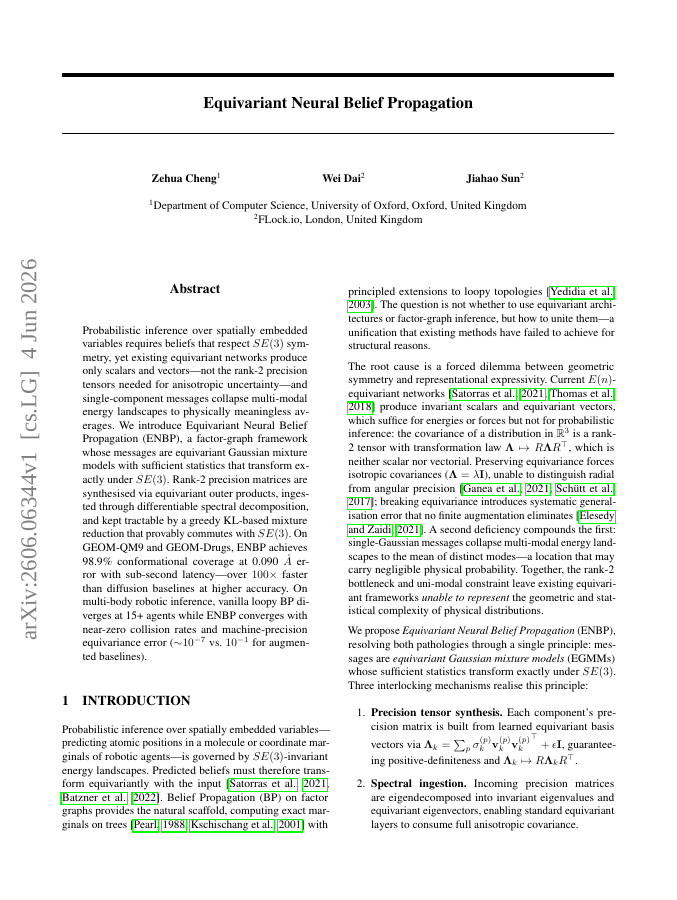
Probabilistic inference over spatially embedded variables requires beliefs that respect SE(3) symmetry, yet existing equivariant networks produce only scalars and vectors -- not the rank-2 precision tensors needed for anisotropic uncertainty, and single-component messages collapse multi-modal energy landscapes to physically meaningless averages. We introduce Equivariant Neural Belief Propagation (ENBP), a factor-graph framework whose messages are equivariant Gaussian mixture models with sufficient statistics that transform exactly under SE(3). Rank-2 precision matrices are synthesised via equivariant outer products, ingested through differentiable spectral decomposition, and kept tractable by a greedy KL-based mixture reduction that provably commutes with SE(3). On GEOM-QM9 and GEOM-Drugs, ENBP achieves 98.9% conformational coverage at 0.090 \mathring{A} error with sub-second latency -- over 100\times faster than diffusion baselines at higher accuracy. On multi-body robotic inference, vanilla loopy BP diverges at 15+ agents while ENBP converges with near-zero collision rates and machine-precision equivariance error ({\sim}10^{-7} vs.\ 10^{-1} for augmented baselines).
Equivariant Neural Belief Propagation
Probabilistic inference over spatially embedded variables requires beliefs that respect $SE(3)$ symmetry, yet existing equivariant networks produce only scalars and vectors -- not the rank-2 precision tensors needed for anisotropic uncertainty, and single-component messages…
- Preview
- Year
- 2026
- Hosting
- Abstract onlyARXIV-DEFAULT
Cite
Notes
Only stored in your browser.
Attribution
- Abstract & full text
- arxiv.org/abs/2606.06344ARXIV-DEFAULT
- TL;DR
- Semantic Scholar