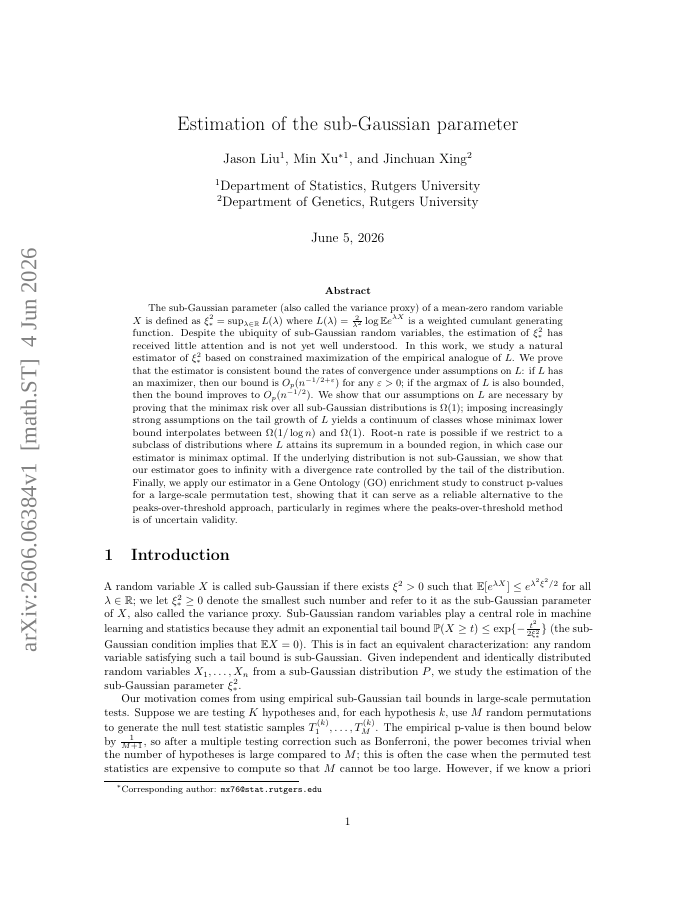
The sub-Gaussian parameter (also called the variance proxy) of a mean-zero random variable X is defined as ξ^2_* = \sup_{λ\in \mathbb{R}} L(λ) where L(λ) = \frac{2}{λ^2} \log \mathbb{E} e^{λX} is a weighted cumulant generating function. Despite the ubiquity of sub-Gaussian random variables, the estimation of ξ^2_* has received little attention and is not yet well understood. In this work, we study a natural estimator of ξ^2_* based on constrained maximization of the empirical analogue of L. We prove that the estimator is consistent bound the rates of convergence under assumptions on L: if L has an maximizer, then our bound is O_p(n^{-1/2 + \varepsilon}) for any \varepsilon > 0; if the argmax of L is also bounded, then the bound improves to O_p(n^{-1/2}). We show that our assumptions on L are necessary by proving that the minimax risk over all sub-Gaussian distributions is Ω(1); imposing increasingly strong assumptions on the tail growth of L yields a continuum of classes whose minimax lower bound interpolates between Ω(1/\log n) and Ω(1). Root-n rate is possible if we restrict to a subclass of distributions where L attains its supremum in a bounded region, in which case our estimator is minimax optimal. If the underlying distribution is not sub-Gaussian, we show that our estimator goes to infinity with a divergence rate controlled by the tail of the distribution. Finally, we apply our estimator in a Gene Ontology (GO) enrichment study to construct p-values for a large-scale permutation test, showing that it can serve as a reliable alternative to the peaks-over-threshold approach, particularly in regimes where the peaks-over-threshold method is of uncertain validity.
Estimation of the sub-Gaussian parameter
The sub-Gaussian parameter (also called the variance proxy) of a mean-zero random variable $X$ is defined as $ξ^2_* = \sup_{λ\in \mathbb{R}} L(λ)$ where $L(λ) = \frac{2}{λ^2} \log \mathbb{E} e^{λX}$ is a weighted cumulant generating function.
- Preview
- Year
- 2026
- Hosting
- Full text hostedCC-BY-4.0
Cite
Notes
Only stored in your browser.
Attribution
- Abstract & full text
- arxiv.org/abs/2606.06384CC-BY-4.0
- TL;DR
- Semantic Scholar