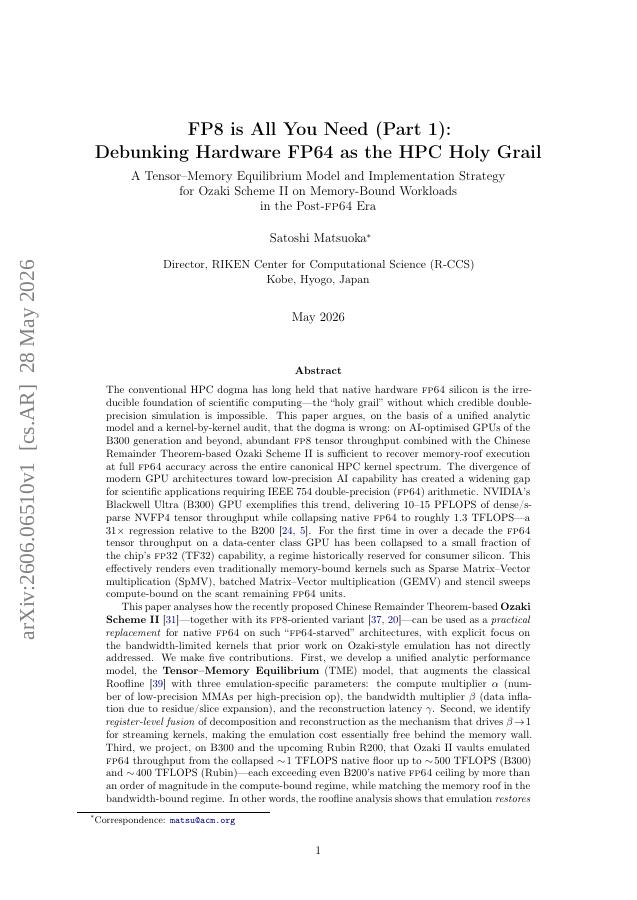
Conventional HPC dogma holds that native hardware FP64 silicon is the irreducible foundation of scientific computing -- the "holy grail" of double-precision simulation. This paper argues the dogma is wrong: on AI-optimised GPUs of the B300 generation and beyond, abundant FP8 tensor throughput combined with the Chinese Remainder Theorem-based Ozaki Scheme II recovers memory-roof execution at full FP64 accuracy across the canonical HPC kernel spectrum. NVIDIA's Blackwell Ultra (B300) collapses native FP64 to 1.3 TFLOPS -- a 31x regression from the B200 -- rendering even memory-bound kernels (SpMV, GEMV, stencils) compute-bound. We make four contributions. First, a unified analytic model, the Tensor-Memory Equilibrium (TME) model, augmenting the Roofline with a compute multiplier alpha, a bandwidth multiplier beta, and a reconstruction latency gamma. Second, we identify register-level fusion as the mechanism driving beta -> 1, making emulation essentially free behind the memory wall. Third, we project that Ozaki II vaults emulated FP64 from the 1 TFLOPS native floor to 500 TFLOPS (B300) and 400 TFLOPS (Rubin R200), exceeding even B200's native FP64 ceiling by over an order of magnitude in the compute-bound regime while matching the memory roof in the bandwidth-bound regime. Fourth, against an H100 baseline, Ozaki II matches or exceeds H100 on every workload studied, versus the up-to-50x regression that B300 native FP64 imposes. Combined with a companion FFT analysis (Kulisch fixed-point reconstruction on the surviving INT32 pipe) and FP32+Kahan reductions reported in the companion Part(2) paper, every surveyed kernel class on B300 reaches the memory roof at full FP64. The evidence supports the title's claim: FP8, with Ozaki II and Kulisch escape routes, is all one needs for production HPC; native FP64 silicon is no longer the holy grail it has been taken to be.
FP8 is All You Need (Part 1): Debunking Hardware FP64 as the HPC Holy Grail
Conventional HPC dogma holds that native hardware FP64 silicon is the irreducible foundation of scientific computing -- the "holy grail" of double-precision simulation.
- Preview
- Year
- 2026
- Hosting
- Full text hostedCC-BY-4.0
Cite
Notes
Only stored in your browser.
Attribution
- Abstract & full text
- arxiv.org/abs/2606.06510CC-BY-4.0
- TL;DR
- Semantic Scholar