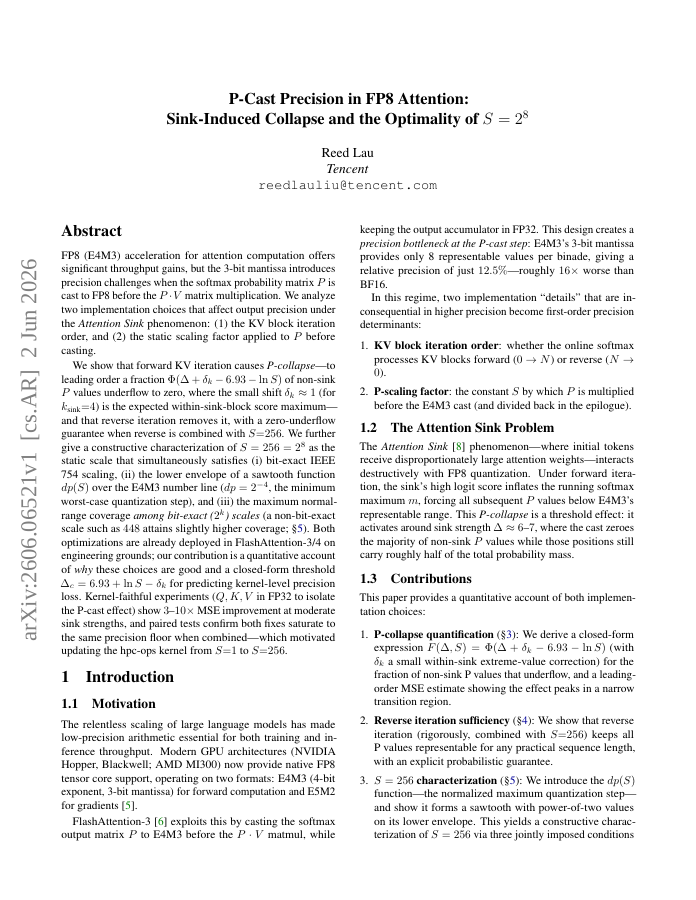
FP8 (E4M3) acceleration for attention computation offers significant throughput gains, but the 3-bit mantissa introduces precision challenges when the softmax probability matrix P is cast to FP8 before the P \cdot V matrix multiplication. We analyze two implementation choices that affect output precision under the Attention Sink phenomenon: (1) the KV block iteration order, and (2) the static scaling factor applied to P before casting. We show that forward KV iteration causes P-collapse -- to leading order a fraction Φ(Δ+ δ_k - 6.93 - \ln S) of non-sink P values underflow to zero, where the small shift δ_k \approx 1 (for k_{sink}{=}4) is the expected within-sink-block score maximum -- and that reverse iteration removes it, with a zero-underflow guarantee when reverse is combined with S{=}256. We further give a constructive characterization of S = 256 = 2^8 as the static scale that simultaneously satisfies (i) bit-exact IEEE 754 scaling, (ii) the lower envelope of a sawtooth function dp(S) over the E4M3 number line (dp = 2^{-4}, the minimum worst-case quantization step), and (iii) the maximum normal-range coverage among bit-exact (2^k) scales (a non-bit-exact scale such as 448 attains slightly higher coverage; sec.5}). Both optimizations are already deployed in FlashAttention-3/4 on engineering grounds; our contribution is a quantitative account of why these choices are good and a closed-form threshold Δ_c = 6.93 + \ln S - δ_k for predicting kernel-level precision loss. Kernel-faithful experiments (Q, K, V in FP32 to isolate the P-cast effect) show 3-10\times MSE improvement at moderate sink strengths, and paired tests confirm both fixes saturate to the same precision floor when combined -- which motivated updating the hpc-ops kernel from S{=}1 to S{=}256.
P-Cast Precision in FP8 Attention: Sink-Induced Collapse and the Optimality of S=2^8
FP8 (E4M3) acceleration for attention computation offers significant throughput gains, but the 3-bit mantissa introduces precision challenges when the softmax probability matrix~$P$ is cast to FP8 before the $P \cdot V$ matrix multiplication.
- Preview
- Year
- 2026
- Hosting
- Full text hostedCC-BY-4.0
Cite
Notes
Only stored in your browser.
Attribution
- Abstract & full text
- arxiv.org/abs/2606.06521CC-BY-4.0
- TL;DR
- Semantic Scholar