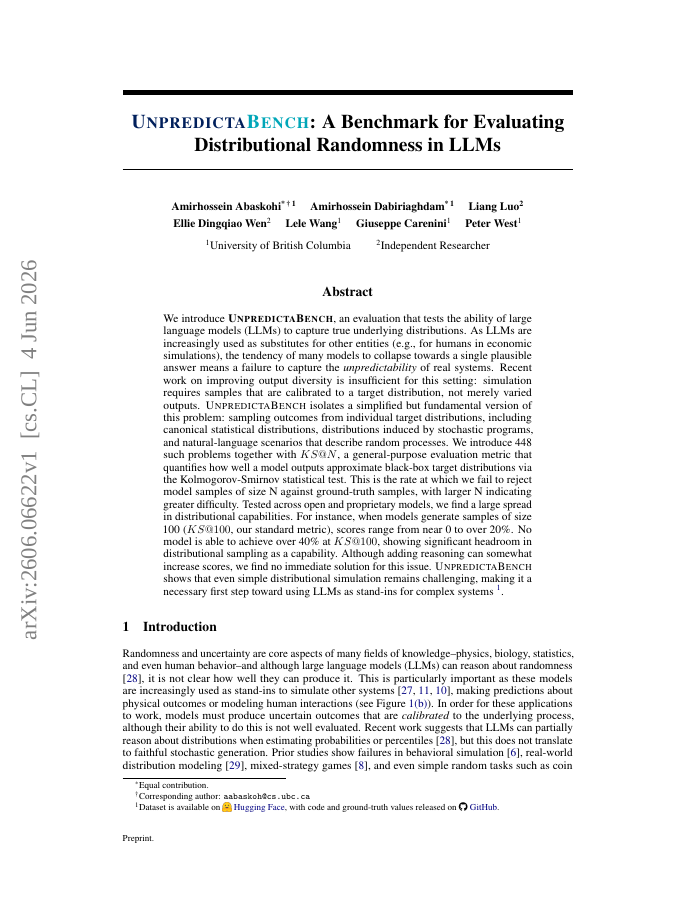
We introduce UnpredictaBench, an evaluation that tests the ability of large language models (LLMs) to capture true underlying distributions. As LLMs are increasingly used as substitutes for other entities (e.g., for humans in economic simulations), the tendency of many models to collapse towards a single plausible answer means a failure to capture the unpredictability of real systems. Recent work on improving output diversity is insufficient for this setting: simulation requires samples that are calibrated to a target distribution, not merely varied outputs. UnpredictaBench isolates a simplified but fundamental version of this problem: sampling outcomes from individual target distributions, including canonical statistical distributions, distributions induced by stochastic programs, and natural-language scenarios that describe random processes. We introduce 448 such problems together with KS@N, a general-purpose evaluation metric that quantifies how well a model outputs approximate black-box target distributions via the Kolmogorov-Smirnov statistical test. This is the rate at which we fail to reject model samples of size N against ground-truth samples, with larger N indicating greater difficulty. Tested across open and proprietary models, we find a large spread in distributional capabilities. For instance, when models generate samples of size 100 (KS@100, our standard metric), scores range from near 0 to over 20%. No model is able to achieve over 40% at KS@100, showing significant headroom in distributional sampling as a capability. Although adding reasoning can somewhat increase scores, we find no immediate solution for this issue. UnpredictaBench shows that even simple distributional simulation remains challenging, making it a necessary first step toward using LLMs as stand-ins for complex systems.
UnpredictaBench: A Benchmark for Evaluating Distributional Randomness in LLMs
We introduce UnpredictaBench, an evaluation that tests the ability of large language models (LLMs) to capture true underlying distributions. As LLMs are increasingly used as substitutes for other entities (e.g., for humans in economic simulations), the tendency of many models to…
- Preview
- Year
- 2026
- Hosting
- Full text hostedCC-BY-4.0
Cite
Notes
Only stored in your browser.
Attribution
- Abstract & full text
- arxiv.org/abs/2606.06622CC-BY-4.0
- TL;DR
- Semantic Scholar