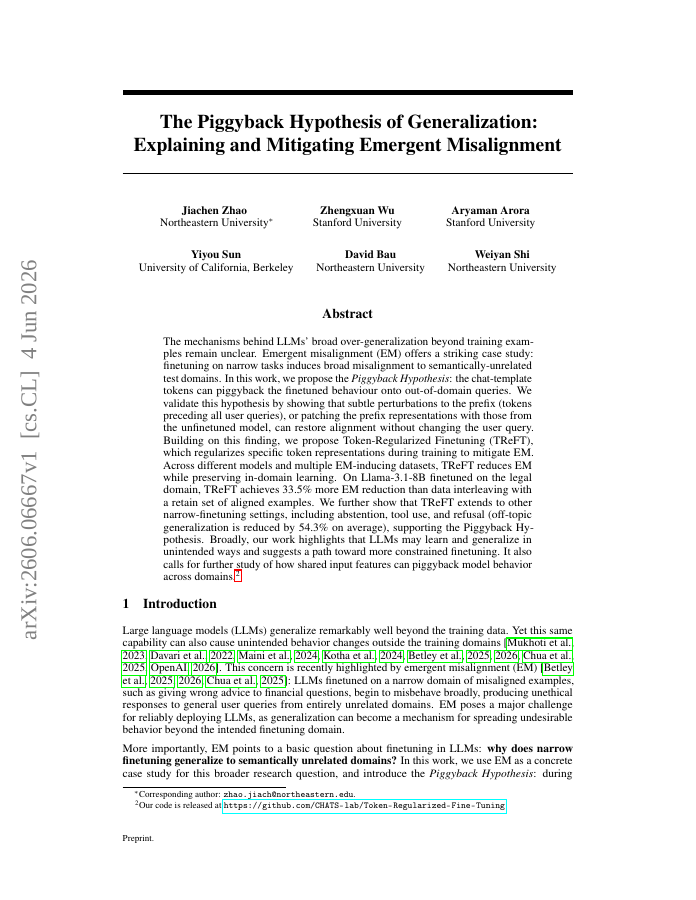
The mechanisms behind LLMs' broad over-generalization beyond training examples remain unclear. Emergent misalignment (EM) offers a striking case study: finetuning on narrow tasks induces broad misalignment to semantically-unrelated test domains. In this work, we propose the Piggyback Hypothesis: the chat-template tokens can piggyback the finetuned behaviour onto out-of-domain queries. We validate this hypothesis by showing that subtle perturbations to the prefix (tokens preceding all user queries), or patching the prefix representations with those from the unfinetuned model, can restore alignment without changing the user query. Building on this finding, we propose Token-Regularized Finetuning (TReFT), which regularizes specific token representations during training to mitigate EM. Across different models and multiple EM-inducing datasets, TReFT reduces EM while preserving in-domain learning. On Llama-3.1-8B finetuned on the legal domain, TReFT achieves 33.5% more EM reduction than data interleaving with a retain set of aligned examples. We further show that TReFT extends to other narrow-finetuning settings, including abstention, tool use, and refusal (off-topic generalization is reduced by 54.3% on average), supporting the Piggyback Hypothesis. Broadly, our work highlights that LLMs may learn and generalize in unintended ways and suggests a path toward more constrained finetuning. It also calls for further study of how shared input features can piggyback model behavior across domains.
The Piggyback Hypothesis of Generalization: Explaining and Mitigating Emergent Misalignment
The mechanisms behind LLMs' broad over-generalization beyond training examples remain unclear. Emergent misalignment (EM) offers a striking case study: finetuning on narrow tasks induces broad misalignment to semantically-unrelated test domains.
- Preview
- Year
- 2026
- Hosting
- Full text hostedCC-BY-4.0
Cite
Notes
Only stored in your browser.
Attribution
- Abstract & full text
- arxiv.org/abs/2606.06667CC-BY-4.0
- TL;DR
- Semantic Scholar