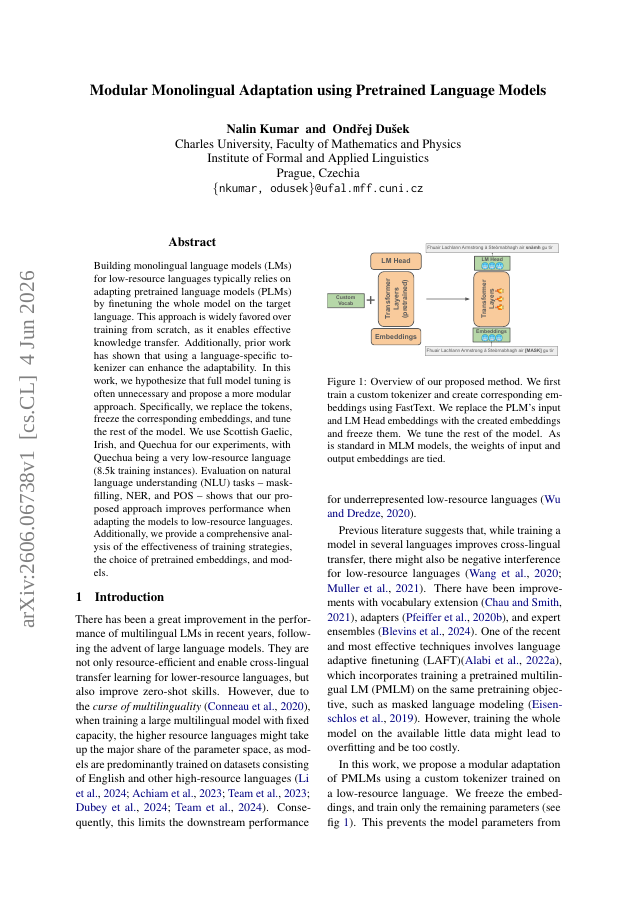
Building monolingual language models (LMs) for low-resource languages typically relies on adapting pretrained language models (PLMs) by finetuning the whole model on the target language. This approach is widely favored over training from scratch, as it enables effective knowledge transfer. Additionally, prior work has shown that using a language-specific tokenizer can enhance the adaptability. In this work, we hypothesize that full model tuning is often unnecessary and propose a more modular approach. Specifically, we replace the tokens, freeze the corresponding embeddings, and tune the rest of the model. We use Scottish Gaelic, Irish, and Quechua for our experiments, with Quechua being a very low-resource language (8.5k training instances). Evaluation on natural language understanding (NLU) tasks -- mask filling, NER, and POS -- shows that our proposed approach improves performance when adapting models to low-resource languages. Additionally, we provide a comprehensive analysis of the effectiveness of training strategies, the choice of pretrained embeddings, and models.
Modular Monolingual Adaptation using Pretrained Language Models
Building monolingual language models (LMs) for low-resource languages typically relies on adapting pretrained language models (PLMs) by finetuning the whole model on the target language.
- Preview
- Year
- 2026
- Hosting
- Full text hostedCC-BY-4.0
Cite
Notes
Only stored in your browser.
Attribution
- Abstract & full text
- arxiv.org/abs/2606.06738CC-BY-4.0
- TL;DR
- Semantic Scholar