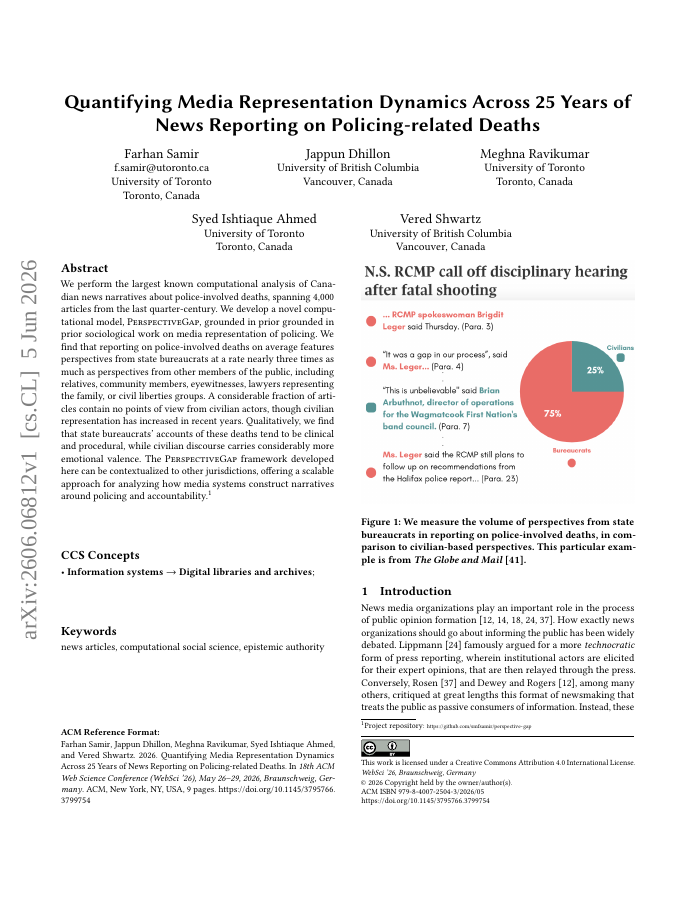
We perform the largest known computational analysis of Canadian news narratives about police-involved deaths, spanning 4,000 articles from the last quarter-century. We develop a novel computational model, PerspectiveGap, grounded in prior sociological work on media representation of policing. We find that reporting on police-involved deaths on average features perspectives from state bureaucrats at a rate nearly three times as much as perspectives from other members of the public, including relatives, community members, eyewitnesses, lawyers representing the family, or civil liberties groups. A considerable fraction of articles contain no points of view from civilian actors, though civilian representation has increased in recent years. Qualitatively, we find that state bureaucrats' accounts of these deaths tend to be clinical and procedural, while civilian discourse carries considerably more emotional valence. The PerspectiveGap framework developed here can be contextualized to other jurisdictions, offering a scalable approach for analyzing how media systems construct narratives around policing and accountability.
Quantifying Media Representation Dynamics Across 25 Years of News Reporting on Policing-related Deaths
We perform the largest known computational analysis of Canadian news narratives about police-involved deaths, spanning 4,000 articles from the last quarter-century. We develop a novel computational model, PerspectiveGap, grounded in prior sociological work on media…
- Preview
- Year
- 2026
- Hosting
- Abstract onlyARXIV-DEFAULT
Cite
Notes
Only stored in your browser.
Attribution
- Abstract & full text
- arxiv.org/abs/2606.06812ARXIV-DEFAULT
- TL;DR
- Semantic Scholar