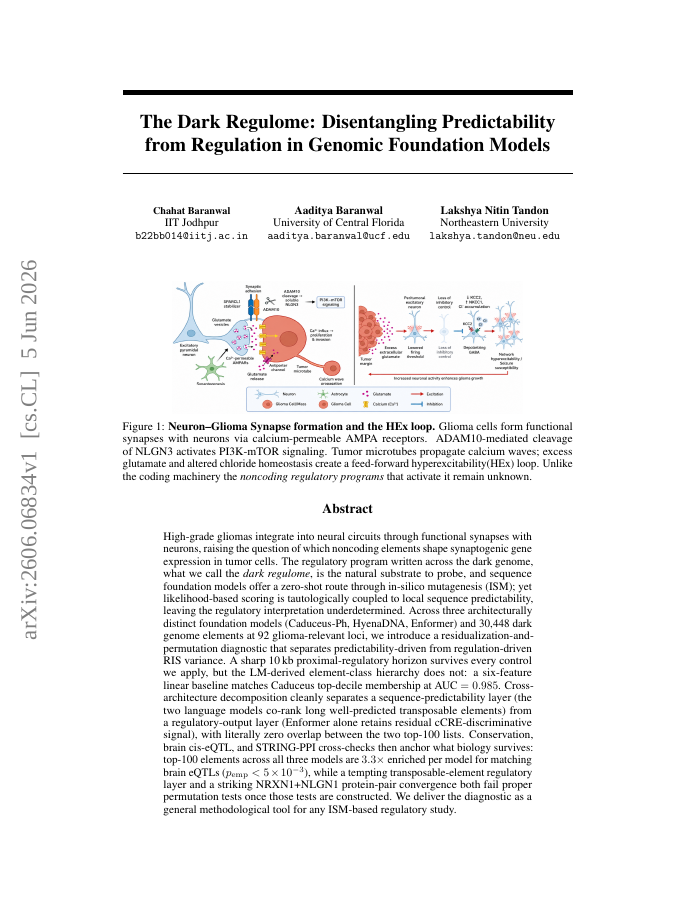
High-grade gliomas integrate into neural circuits through functional synapses with neurons, raising the question of which noncoding elements shape synaptogenic gene expression in tumor cells. The regulatory program written across the dark genome, what we call the dark regulome, is the natural substrate to probe, and sequence foundation models offer a zero-shot route through in-silico mutagenesis (ISM); yet likelihood-based scoring is tautologically coupled to local sequence predictability, leaving the regulatory interpretation underdetermined. Across three architecturally distinct foundation models (Caduceus-Ph, HyenaDNA, Enformer) and 30,448 dark genome elements at 92 glioma-relevant loci, we introduce a residualization-and-permutation diagnostic that separates predictability-driven from regulation-driven RIS variance. A sharp 10kb proximal-regulatory horizon survives every control we apply, but the LM-derived element-class hierarchy does not: a six-feature linear baseline matches Caduceus top-decile membership at AUC = 0.985. Cross-architecture decomposition cleanly separates a sequence-predictability layer (the two language models co-rank long well-predicted transposable elements) from a regulatory-output layer (Enformer alone retains residual cCRE-discriminative signal), with literally zero overlap between the two top-100 lists. Conservation, brain cis-eQTL, and STRING-PPI cross-checks then anchor what biology survives: top-100 elements across all three models are 3.3\times enriched per model for matching brain eQTLs (p_emp < 5\times 10^{-3}), while a tempting transposable-element regulatory layer and a striking NRXN1+NLGN1 protein-pair convergence both fail proper permutation tests once those tests are constructed. We deliver the diagnostic as a general methodological tool for any ISM-based regulatory study.
The Dark Regulome: Disentangling Predictability from Regulation in Genomic Foundation Models
High-grade gliomas integrate into neural circuits through functional synapses with neurons, raising the question of which noncoding elements shape synaptogenic gene expression in tumor cells.
- Preview
- Year
- 2026
- Hosting
- Full text hostedCC-BY-4.0
Cite
Notes
Only stored in your browser.
Attribution
- Abstract & full text
- arxiv.org/abs/2606.06834CC-BY-4.0
- TL;DR
- Semantic Scholar