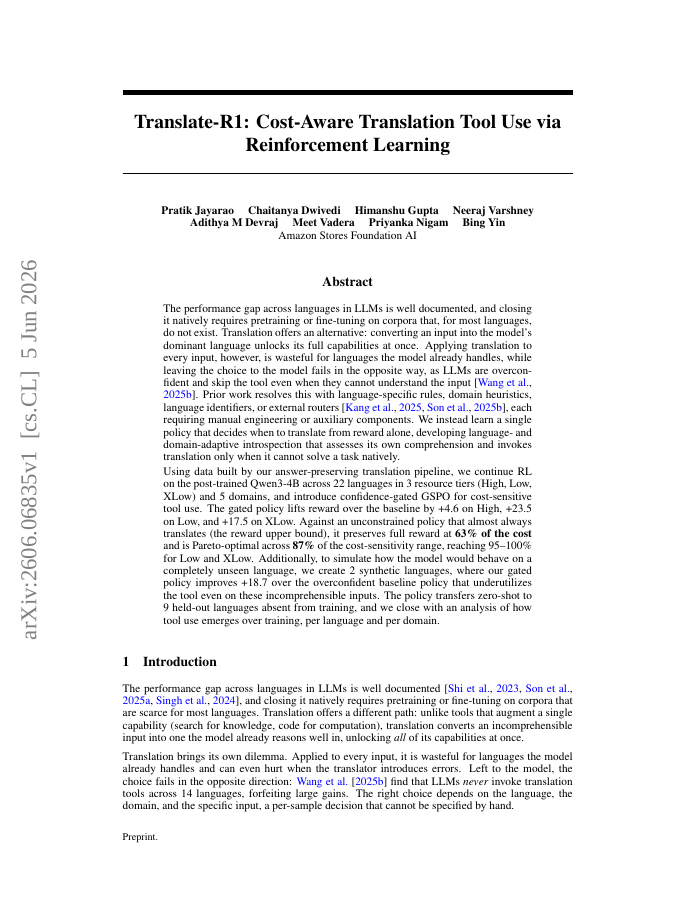
The performance gap across languages in LLMs is well documented, and closing it natively requires pretraining or fine-tuning on corpora that, for most languages, do not exist. Translation offers an alternative: converting an input into the model's dominant language unlocks its full capabilities at once. Applying translation to every input, however, is wasteful for languages the model already handles, while leaving the choice to the model fails in the opposite way, as LLMs are overconfident and skip the tool even when they cannot understand the input. Prior work resolves this with language-specific rules, domain heuristics, language identifiers, or external routers, each requiring manual engineering. We instead learn a single policy that decides when to translate from reward alone, developing language- and domain-adaptive introspection that assesses its own comprehension and invokes translation only when it cannot solve a task natively. Using data built by our answer-preserving translation pipeline, we continue RL on the post-trained Qwen3-4B across 22 languages in 3 resource tiers (High, Low, XLow) and 5 domains, and introduce confidence-gated GSPO for cost-sensitive tool use. The gated policy lifts reward over the baseline by +4.6 on High, +23.5 on Low, and +17.5 on XLow. Against an unconstrained policy that almost always translates, it preserves full reward at 63% of the cost and is Pareto-optimal across 87% of the cost-sensitivity range. Additionally, to simulate behavior on a completely unseen language, we create 2 synthetic languages, where our gated policy improves +18.7 over the overconfident baseline that underutilizes the tool even on these incomprehensible inputs. The policy transfers zero-shot to 9 held-out languages, and we analyze how tool use emerges over training, per language and per domain.
Translate-R1: Cost-Aware Translation Tool Use via Reinforcement Learning
The performance gap across languages in LLMs is well documented, and closing it natively requires pretraining or fine-tuning on corpora that, for most languages, do not exist.
- Preview
- Year
- 2026
- Hosting
- Full text hostedCC-BY-4.0
Cite
Notes
Only stored in your browser.
Attribution
- Abstract & full text
- arxiv.org/abs/2606.06835CC-BY-4.0
- TL;DR
- Semantic Scholar