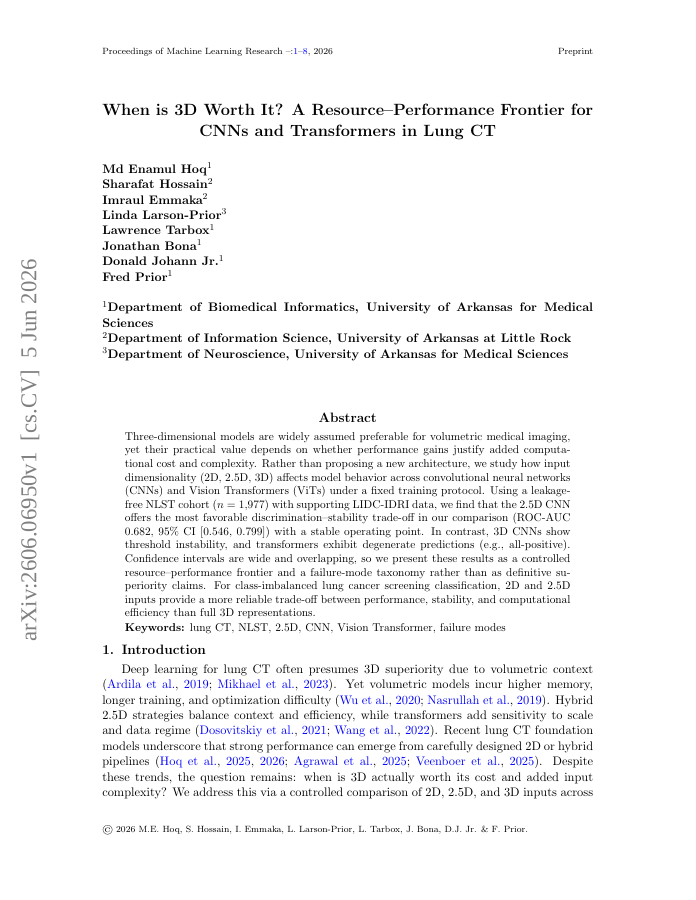
Three-dimensional models are widely assumed preferable for volumetric medical imaging, yet their practical value depends on whether performance gains justify added computational cost and complexity. Rather than proposing a new architecture, we study how input dimensionality (2D, 2.5D, 3D) affects model behavior across convolutional neural networks (CNNs) and Vision Transformers (ViTs) under a fixed training protocol. Using a leakage-free NLST cohort (n = 1,977) with supporting LIDC-IDRI data, we find that the 2.5D CNN offers the most favorable discrimination-stability trade-off in our comparison (ROC-AUC 0.682, 95% CI [0.546, 0.799]) with a stable operating point. In contrast, 3D CNNs show threshold instability, and transformers exhibit degenerate predictions, such as all-positive predictions. Confidence intervals are wide and overlapping, so we present these results as a controlled resource-performance frontier and a failure-mode taxonomy rather than as definitive superiority claims. For class-imbalanced lung cancer screening classification, 2D and 2.5D inputs provide a more reliable trade-off between performance, stability, and computational efficiency than full 3D representations.
When is 3D Worth It? A Resource-Performance Frontier for CNNs and Transformers in Lung CT
Three-dimensional models are widely assumed preferable for volumetric medical imaging, yet their practical value depends on whether performance gains justify added computational cost and complexity.
- Preview
- Year
- 2026
- Hosting
- Full text hostedCC-BY-4.0
Cite
Notes
Only stored in your browser.
Attribution
- Abstract & full text
- arxiv.org/abs/2606.06950CC-BY-4.0
- TL;DR
- Semantic Scholar