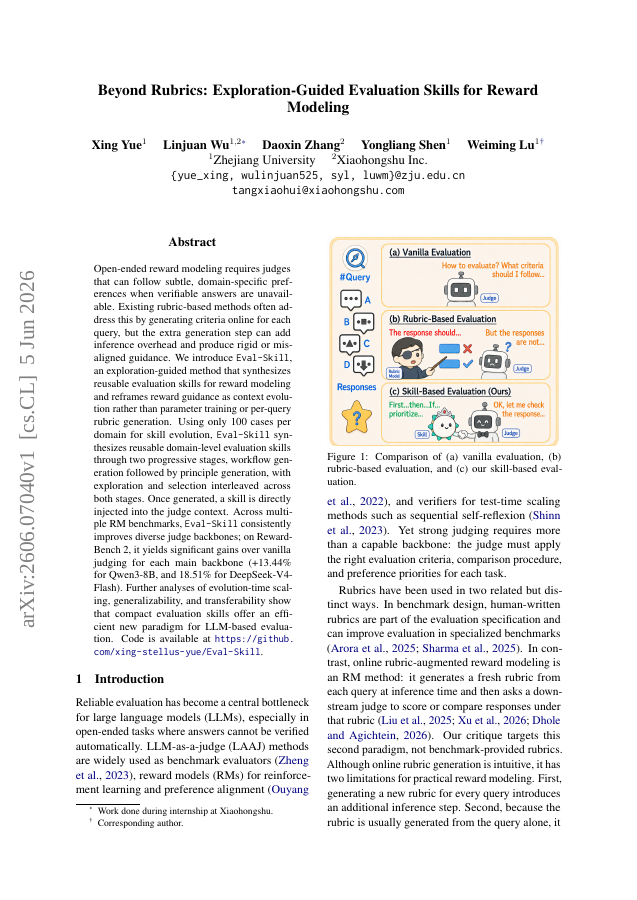
Open-ended reward modeling requires judges that can follow subtle, domain-specific preferences when verifiable answers are unavailable. Existing rubric-based methods often address this by generating criteria online for each query, but the extra generation step can add inference overhead and produce rigid or misaligned guidance. We introduce Eval-Skill, an exploration-guided method that synthesizes reusable evaluation skills for reward modeling and reframes reward guidance as context evolution rather than parameter training or per-query rubric generation. Using only 100 cases per domain for skill evolution, Eval-Skill synthesizes reusable domain-level evaluation skills through two progressive stages, workflow generation followed by principle generation, with exploration and selection interleaved across both stages. Once generated, a skill is directly injected into the judge context. Across multiple RM benchmarks, Eval-Skill consistently improves diverse judge backbones; on RewardBench 2, it yields significant gains over vanilla judging for each main backbone (+13.44% for Qwen3-8B, and 18.51% for DeepSeek-V4-Flash). Further analyses of evolution-time scaling, generalizability, and transferability show that compact evaluation skills offer an efficient new paradigm for LLM-based evaluation. Code is available at https://github.com/xing-stellus-yue/Eval-Skill.
Beyond Rubrics: Exploration-Guided Evaluation Skills for Reward Modeling
Open-ended reward modeling requires judges that can follow subtle, domain-specific preferences when verifiable answers are unavailable. Existing rubric-based methods often address this by generating criteria online for each query, but the extra generation step can add inference…
- Preview
- Year
- 2026
- Hosting
- Abstract onlyARXIV-DEFAULT
Cite
Notes
Only stored in your browser.
Attribution
- Abstract & full text
- arxiv.org/abs/2606.07040ARXIV-DEFAULT
- TL;DR
- Semantic Scholar