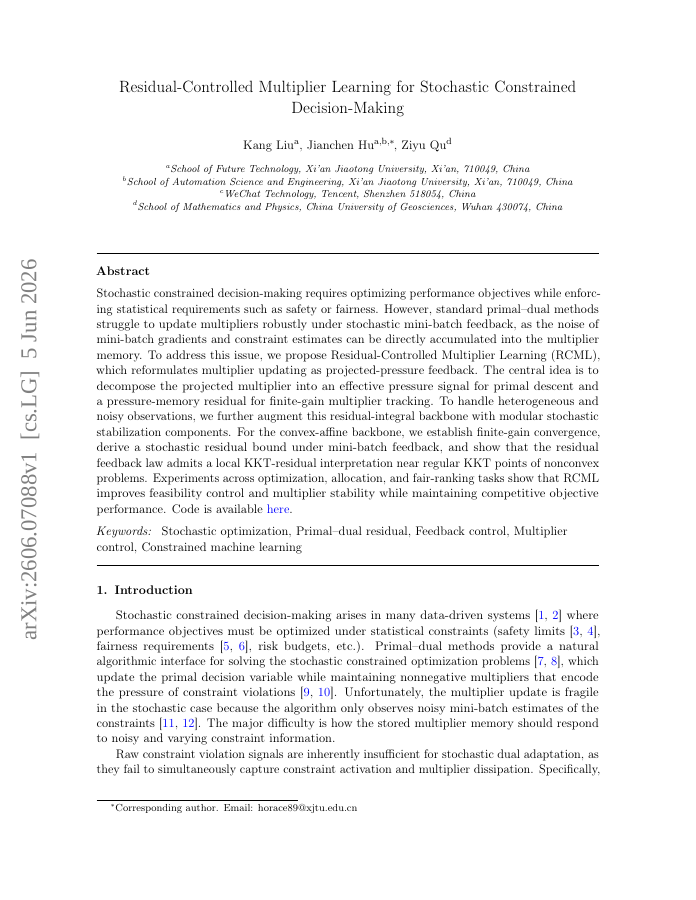
Stochastic constrained decision-making requires optimizing performance objectives while enforcing statistical requirements such as safety or fairness. However, standard primal--dual methods struggle to update multipliers robustly under stochastic mini-batch feedback, as the noise of mini-batch gradients and constraint estimates can be directly accumulated into the multiplier memory. To address this issue, we propose Residual-Controlled Multiplier Learning (RCML), which reformulates multiplier updating as projected-pressure feedback. The central idea is to decompose the projected multiplier into an effective pressure signal for primal descent and a pressure-memory residual for finite-gain multiplier tracking. To handle heterogeneous and noisy observations, we further augment this residual-integral backbone with modular stochastic stabilization components. For the convex-affine backbone, we establish finite-gain convergence, derive a stochastic residual bound under mini-batch feedback, and show that the residual feedback law admits a local KKT-residual interpretation near regular KKT points of nonconvex problems. Experiments across optimization, allocation, and fair-ranking tasks show that RCML improves feasibility control and multiplier stability while maintaining competitive objective performance. Code is available here.
Residual-Controlled Multiplier Learning for Stochastic Constrained Decision-Making
Stochastic constrained decision-making requires optimizing performance objectives while enforcing statistical requirements such as safety or fairness. However, standard primal--dual methods struggle to update multipliers robustly under stochastic mini-batch feedback, as the…
- Preview
- Year
- 2026
- Hosting
- Abstract onlyARXIV-DEFAULT
Cite
Notes
Only stored in your browser.
Attribution
- Abstract & full text
- arxiv.org/abs/2606.07088ARXIV-DEFAULT
- TL;DR
- Semantic Scholar