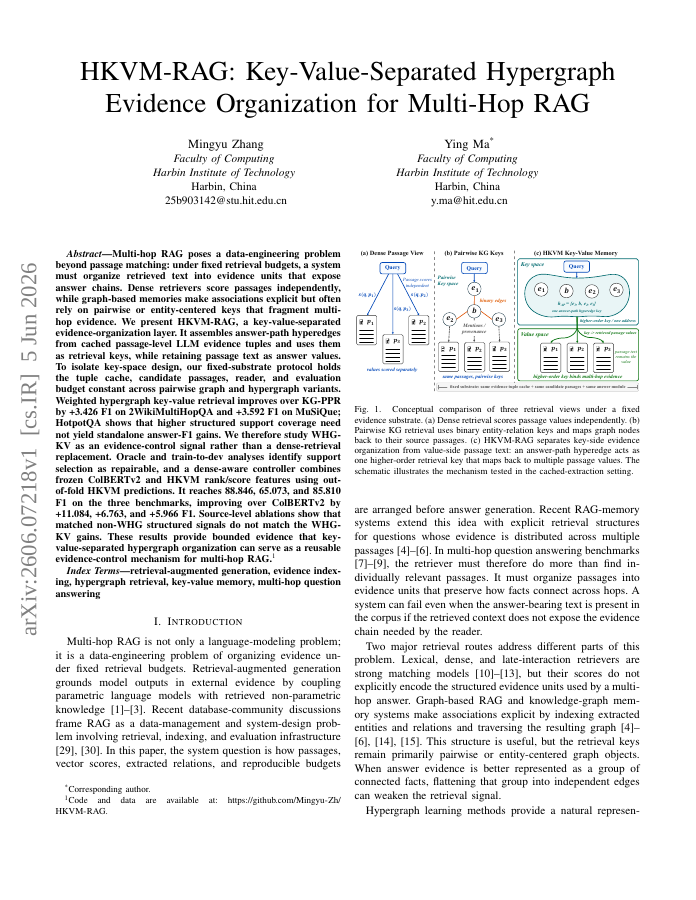
Multi-hop RAG poses a data-engineering problem beyond passage matching: under fixed retrieval budgets, a system must organize retrieved text into evidence units that expose answer chains. Dense retrievers score passages independently, while graph-based memories make associations explicit but often rely on pairwise or entity-centered keys that fragment multi-hop evidence. We present HKVM-RAG, a key-value-separated evidence-organization layer. It assembles answer-path hyperedges from cached passage-level LLM evidence tuples and uses them as retrieval keys, while retaining passage text as answer values. To isolate key-space design, our fixed-substrate protocol holds the tuple cache, candidate passages, reader, and evaluation budget constant across pairwise graph and hypergraph variants. Weighted hypergraph key-value retrieval improves over KG-PPR by +3.426 F1 on 2WikiMultiHopQA and +3.592 F1 on MuSiQue; HotpotQA shows that higher structured support coverage need not yield standalone answer-F1 gains. We therefore study WHG-KV as an evidence-control signal rather than a dense-retrieval replacement. Oracle and train-to-dev analyses identify support selection as repairable, and a dense-aware controller combines frozen ColBERTv2 and HKVM rank/score features using out-of-fold HKVM predictions. It reaches 88.846, 65.073, and 85.810 F1 on the three benchmarks, improving over ColBERTv2 by +11.084, +6.763, and +5.966 F1. Source-level ablations show that matched non-WHG structured signals do not match the WHG-KV gains. These results provide bounded evidence that key-value-separated hypergraph organization can serve as a reusable evidence-control mechanism for multi-hop RAG.
HKVM-RAG: Key-Value-Separated Hypergraph Evidence Organization for Multi-Hop RAG
Multi-hop RAG poses a data-engineering problem beyond passage matching: under fixed retrieval budgets, a system must organize retrieved text into evidence units that expose answer chains.
- Preview
- Year
- 2026
- Hosting
- Abstract onlyARXIV-DEFAULT
Cite
Notes
Only stored in your browser.
Attribution
- Abstract & full text
- arxiv.org/abs/2606.07218ARXIV-DEFAULT
- TL;DR
- Semantic Scholar