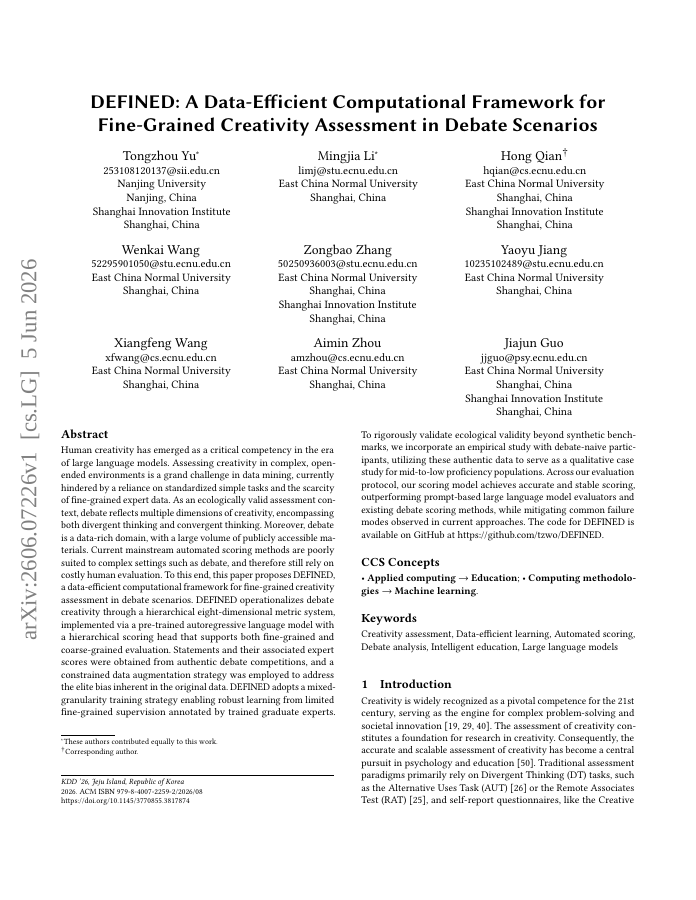
Human creativity has emerged as a critical competency in the era of large language models. Assessing creativity in complex, open-ended environments is a grand challenge in data mining, currently hindered by a reliance on standardized simple tasks and the scarcity of fine-grained expert data. As an ecologically valid assessment context, debate reflects multiple dimensions of creativity, encompassing both divergent thinking and convergent thinking. Moreover, debate is a data-rich domain, with a large volume of publicly accessible materials. Current mainstream automated scoring methods are poorly suited to complex settings such as debate, and therefore still rely on costly human evaluation. To this end, this paper proposes DEFINED, a data-efficient computational framework for fine-grained creativity assessment in debate scenarios. DEFINED operationalizes debate creativity through a hierarchical eight-dimensional metric system, implemented via a pre-trained autoregressive language model with a hierarchical scoring head that supports both fine-grained and coarse-grained evaluation. Statements and their associated expert scores were obtained from authentic debate competitions, and a constrained data augmentation strategy was employed to address the elite bias inherent in the original data. DEFINED adopts a mixed-granularity training strategy enabling robust learning from limited fine-grained supervision annotated by trained graduate experts. To rigorously validate ecological validity beyond synthetic benchmarks, we incorporate an empirical study with debate-naive participants, utilizing these authentic data to serve as a qualitative case study for mid-to-low proficiency populations. Across our evaluation protocol, our scoring model achieves accurate and stable scoring, outperforming prompt-based large language model evaluators and existing debate scoring methods.
DEFINED: A Data-Efficient Computational Framework for Fine-Grained Creativity Assessment in Debate Scenarios
Human creativity has emerged as a critical competency in the era of large language models. Assessing creativity in complex, open-ended environments is a grand challenge in data mining, currently hindered by a reliance on standardized simple tasks and the scarcity of fine-grained…
- Preview
- Year
- 2026
- Hosting
- Excerpt onlyCC-BY-NC-4.0
Cite
Notes
Only stored in your browser.
Attribution
- Abstract & full text
- arxiv.org/abs/2606.07226CC-BY-NC-4.0
- TL;DR
- Semantic Scholar