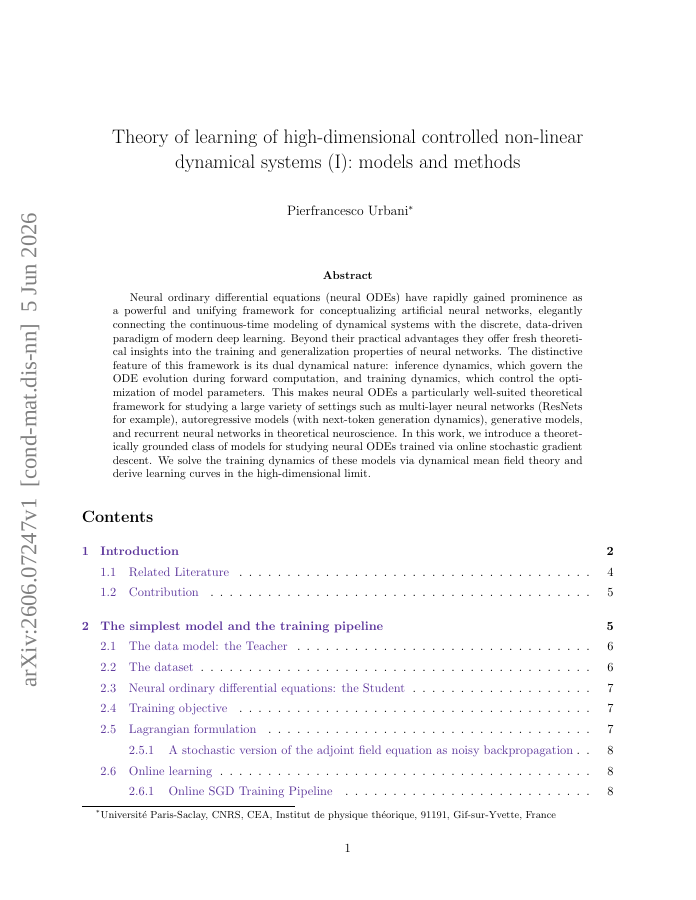
Neural ordinary differential equations (neural ODEs) have rapidly gained prominence as a powerful and unifying framework for conceptualizing artificial neural networks, elegantly connecting the continuous-time modeling of dynamical systems with the discrete, data-driven paradigm of modern deep learning. Beyond their practical advantages they offer fresh theoretical insights into the training and generalization properties of neural networks. The distinctive feature of this framework is its dual dynamical nature: inference dynamics, which govern the ODE evolution during forward computation, and training dynamics, which control the optimization of model parameters. This makes neural ODEs a particularly well-suited theoretical framework for studying a large variety of settings such as multi-layer neural networks (ResNets for example), autoregressive models (with next-token generation dynamics), generative models, and recurrent neural networks in theoretical neuroscience. In this work, we introduce a theoretically grounded class of models for studying neural ODEs trained via online stochastic gradient descent. We solve the training dynamics of these models via dynamical mean field theory and derive learning curves in the high-dimensional limit.
Theory of learning of high-dimensional controlled non-linear dynamical systems (I): models and methods
Neural ordinary differential equations (neural ODEs) have rapidly gained prominence as a powerful and unifying framework for conceptualizing artificial neural networks, elegantly connecting the continuous-time modeling of dynamical systems with the discrete, data-driven paradigm…
- Preview
- Year
- 2026
- Hosting
- Abstract onlyARXIV-DEFAULT
Cite
Notes
Only stored in your browser.
Attribution
- Abstract & full text
- arxiv.org/abs/2606.07247ARXIV-DEFAULT
- TL;DR
- Semantic Scholar