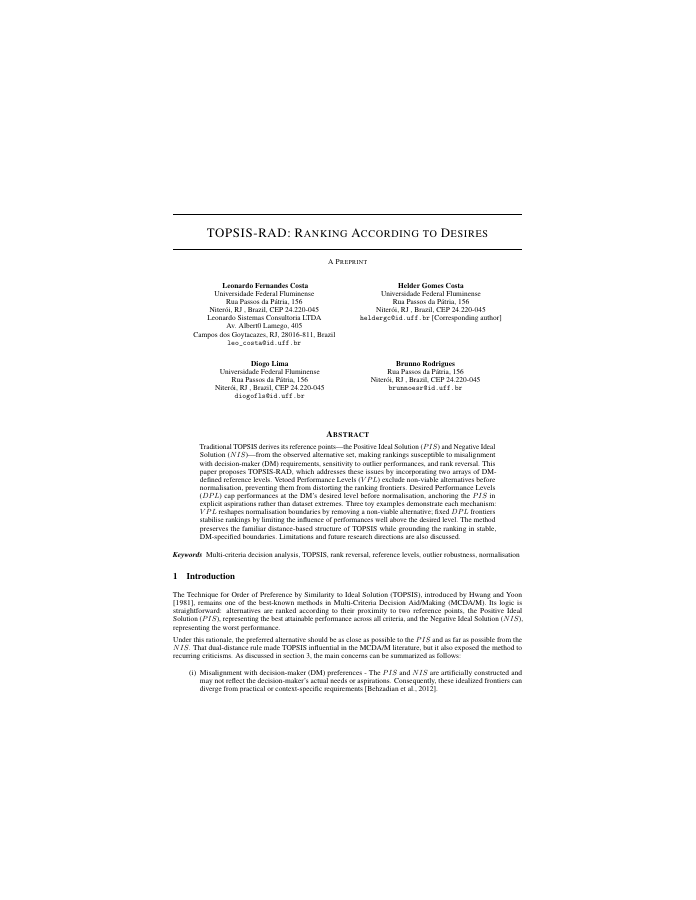
Traditional TOPSIS derives its reference points -- the Positive Ideal Solution (PIS) and Negative Ideal Solution (NIS) -- from the observed alternative set, making rankings susceptible to misalignment with decision-maker (DM) requirements, sensitivity to outlier performances, and rank reversal. This paper proposes TOPSIS-RAD, which addresses these issues by incorporating two arrays of DM-defined reference levels. Vetoed Performance Levels (VPL) exclude non-viable alternatives before normalisation, preventing them from distorting the ranking frontiers. Desired Performance Levels (DPL) cap performances at the DM's desired level before normalisation, anchoring the PIS in explicit aspirations rather than dataset extremes. Three toy examples demonstrate each mechanism: VPL reshapes normalisation boundaries by removing a non-viable alternative; fixed DPL frontiers stabilise rankings by limiting the influence of performances well above the desired level. The method preserves the familiar distance-based structure of TOPSIS while grounding the ranking in stable, DM-specified boundaries. Limitations and future research directions are also discussed.
TOPSIS-RAD: Ranking According to Desires
Traditional TOPSIS derives its reference points -- the Positive Ideal Solution ($PIS$) and Negative Ideal Solution ($NIS$) -- from the observed alternative set, making rankings susceptible to misalignment with decision-maker (DM) requirements, sensitivity to outlier…
- Preview
- Year
- 2026
- Hosting
- Full text hostedCC-BY-4.0
Cite
Notes
Only stored in your browser.
Attribution
- Abstract & full text
- arxiv.org/abs/2606.07253CC-BY-4.0
- TL;DR
- Semantic Scholar