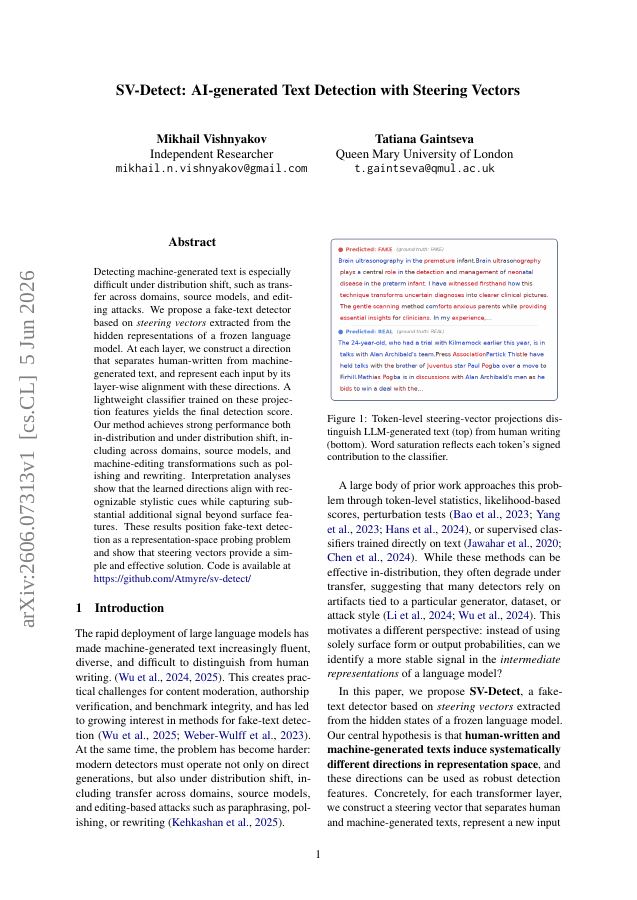
Detecting machine-generated text is especially difficult under distribution shift, such as transfer across domains, source models, and editing attacks. We propose a fake-text detector based on steering vectors extracted from the hidden representations of a frozen language model. At each layer, we construct a direction that separates human-written from machine-generated text, and represent each input by its layer-wise alignment with these directions. A lightweight classifier trained on these projection features yields the final detection score. Our method achieves strong performance both in-distribution and under distribution shift, including across domains, source models, and machine-editing transformations such as polishing and rewriting. Interpretation analyses show that the learned directions align with recognizable stylistic cues while capturing substantial additional signal beyond surface features. These results position fake-text detection as a representation-space probing problem and show that steering vectors provide a simple and effective solution.
SV-Detect: AI-generated Text Detection with Steering Vectors
Detecting machine-generated text is especially difficult under distribution shift, such as transfer across domains, source models, and editing attacks. We propose a fake-text detector based on steering vectors extracted from the hidden representations of a frozen language model.
- Preview
- Year
- 2026
- Hosting
- Full text hostedCC-BY-4.0
Cite
Notes
Only stored in your browser.
Attribution
- Abstract & full text
- arxiv.org/abs/2606.07313CC-BY-4.0
- TL;DR
- Semantic Scholar